Showing posts with label Basil Rathbone. Show all posts

Apr 7, 2021

On Blu-ray: Ronald Colman in Charles Dickens' A Tale of Two Cities (1935)


The 1935 MGM production of Charles Dickens’ A Tale of Two Cities was the fourth screen adaptation of the novel and the first to be made with sound. It followed the similarly grand David Copperfield, which had been released earlier in the year. While the film explores the drama of the French Revolution on a large scale, it is almost intimate in the way it explores love and sacrifice. I recently watched it on a new Blu-ray release from Warner Archive. 

The casting of the film for the most part is perfect because it is utterly unsurprising. Basil Rathbone settles cozily into his role as an icy, cruel Marquis, Edna Mae Oliver ties her bonnet and plays the perfect protective servant, and Elizabeth Allen performs with the reserve of someone who knows she is meant to be decorative. 

Ronald Colman on the other hand is a revelation. Throughout most of his career, he tended to play dashing, romantic, and plainly heroic characters. It’s fascinating to see him play a more downbeat and morally complex character. Much like Cary Grant, he could skate by on his charm and handsome face, but he had more to offer as an actor. This was a role he had long wanted and studied for and his total commitment shows in the performance. 

A Tale of Two Cities is a busy film. You get the feeling of a bag being quickly packed, stuffed full of important things that can’t be missed though there really isn’t enough room for everything. It’s a familiar issue for classic adaptations and especially the character-filled stories of Dickens. 

Still, it is an effective production and grand in a way only MGM could achieve at the time. While the crowds and clatter can be invigorating, the best moments focus on Colman and his personal response to public chaos. When in the midst of coldly efficient violence and cruelty he calmly meets his fate, it is immensely touching. In fact, it’s one of the great moments of classic cinema. 

Special features on the disc include a theatrical trailer, the cartoons Hey, Hey Fever and Honeyland, audio of a radio adaptation of the story also starring Colman, and the amusing stereoscopic demonstration short Audioscopicks, which was nominated for an Oscar. 

Many thanks to Warner Archive for providing a copy of the film for review. To order, visit The Warner Archive Collection .

May 24, 2018

On DVD: 5 Pre-Codes from Warner Archive


I love it when Warner Archive releases a flood of pre-codes. It almost makes up for the end of the Forbidden Hollywood box set series--almost. The company has thankfully stayed true to its promise to continue to make films from this era available on DVD. I enjoyed this latest batch, which includes a pair of flicks starring Ronald Coleman, early Kay Francis and Loretta Young talkies, and a good mix of genres.

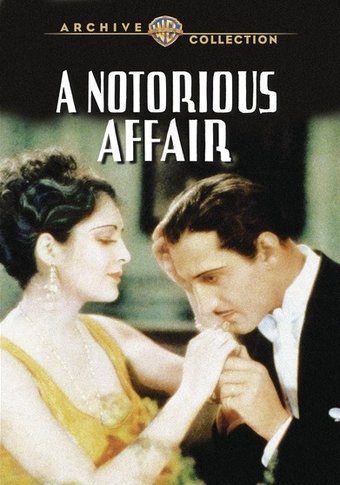
A Notorious Affair (1930) is an unusual melodrama in that it features Kay Francis, but stars Billie Dove in what would eventually be the standard Francis role. Dove is a young heiress who falls in love with an impoverished musician (Basil Rathbone) and leaves her wealthy enclave for a more humble life. Rathbone falls for his thrill seeking patron, the Countess Balakiereff (Francis), causing Dove heartbreak and falling into ill health himself.

After watching Francis suffer nobly through so many melodramas, it is fun to see her be bad. With her slicked back bob and dangerous smile, she is the type to cap a flirtation with an attractive specimen below her balcony by tossing down her keys. I would have loved to have seen her in more roles like these, because it looks like she’s having a blast.

It’s rough to watch the usually dashing and devilish Rathbone play a weak and whiny character, though he does possess some consumptive glamour. Dove seems to think she deserves him, though she has better prospects. Still, despite her faulty romantic radar, she suffers elegantly, with those big eyes and a delicate bird beak nose that points down just so.


The Ship From Shanghai (1930) begins with a jaunty Chinese ensemble playing Singin’ in the Rain in a Shanghai nightclub. It’s about the last light moment in this tense flick that all but creates the template for many a shipbound terror flick.

Wealthy Conrad Nagel and and Kay Johnson join a group from their set on 3-month yacht voyage across the Atlantic. There they are eventually held captive by the vengeful ship steward (Louis Wolheim) and crew, who despise the snooty passengers and their high-handed ways. Of course, the truth is the steward only longs to be a part of their world, a fact made clear when he puts the moves on Johnson.

The film takes a sharp dive from playful luxury, to sweaty, nasty horror. You spend the first part of the film observing the off-putting privileged passengers and the next repulsed by Wolheim and his men. It isn’t enthralling drama, but it serves its purpose as a solid entertainment and keeps a good pace through its 67 minute running time.


The Devil to Pay (1930), stars Ronald Coleman as an irresponsible playboy attempting to bounce back from his careless loss of another chunk of his father’s fortune. Cut off from the family coffers, he returns to his mistress, but soon abandons her for a young heiress. This airy set-up then begins to deflate, as the necessary romantic conflict is something more easy to resolve than the plot would have it.

The film features a teenage Loretta Young as the heiress and Myrna Loy as Coleman’s actress mistress in a rare early role where she doesn’t play an Oriental temptress. As Coleman’s love interests, the effect they have varies widely. While Loy is charming and more age-appropriate for her male lead, she hasn’t yet honed the edges of the sharply appealing persona that would be the cornerstone of her legend. On the other hand, Young seems to have arrived in the talkies with her image fully-formed, if a bit coltish.

Coleman is reliably elegant and mischievous in a role that John Gilbert could also have mastered with ease. It’s a fun romp, enjoyable because for most of the running time you get the simple enjoyment of watching these attractive people at play.


Condemned (1929) also headlines Ronald Coleman, this time as a prisoner on Devil’s Island. Upon his arrival on a tightly-packed ship, he and his fellow prisoners are told there is not escape, upon which he turns to wink at his friend (Louise Wolheim). The warden (Dudley Diggs) observes Coleman’s elegant manner and decides to put him to work for his wife (Ann Harding) in their home.

The pair hit it off right away, establishing a friendly rapport. They are two attractive people though, and the inevitable happens: Coleman buys Harding a monkey in the market, inflaming her passions and Diggs’ envy. The pair plan to escape together, with the help of  Wolheim (he's one of those bruisers with a big heart and a delightfully smooshed nose).

Coleman and Harding have a solid, if not sizzling, chemistry and the action moves along efficiently. While much of the story runs along familiar lines, there are a few good jolts away from predictability.

Of the films reviewed here, Condemned has the most notable wear and tear, with lots of hiss and popping on the soundtrack, though the image is for the most part clean and clear.


The best of the bunch is The Lost Squadron (1932), a post-World War I drama set in Hollywood. Upon release from the army, a quartet of American fliers (Richard Dix, Joel McCrea, Robert Armstrong, and Hugh Herbert) pledges allegiance to each other and their fallen countrymen, who they refer to as “the lost squadron.” Jobs are scarce, but alcoholic Armstrong finds success as a stuntman in the movies and eventually the other three find work alongside him.

Hollywood is no safe haven though, as Dix runs afoul of a sadistic director (Erich von Stroheim). The men find themselves faced with an enemy more deadly than any they ever faced in wartime. Mary Astor and Dorothy Jordan are the women in their lives, and while this is an emphatically male-driven film, these actresses have a powerful presence.

The Lost Squadron has an unusually vibrant soundscape for an early talkie, drawing much of its drama from eerily rushing wind, whistling, and the shifts between quietly eerie or contemplative scenes and more raucous, celebratory moments. It is this high level of craft, and the charisma of the varied cast which make this an unsung gem worthy of classic status.

Many thanks to Warner Archive for providing copies of the films for review. These are Manufacture on Demand (MOD) DVDs. To order, visit The Warner Archive Collection.

Dec 15, 2017

Double Dealing DVDs: Kind Lady (1935/1951) and Strictly Dishonorable (1931/1951)


Ever try watching a double feature that is two versions of the same story? I did it at a film festival once. It was a screening of the silent Chinese film Cave of the Spider Woman (1927) and its glossier go-go remake The Cave of the Silken Web (1967). What struck me most about the pairing was how much more I enjoyed the individual films when I had the added interest of comparing them to each other.

That is the experience I had watching a pair of original/remake double features from Warner Archive recently. The DVD double feature debuts of Strictly Dishonorable (1931/1951) and Kind Lady (1935/1951) stuck with me a lot longer than they would had I seen only one of the films in each set. The former pair was pleasant fun, while the latter filled me with dread, but won my appreciation.

Strictly Dishonorable (1931/1951)

Though the source of this comedy romance is a successful Preston Sturges play, neither screen version has quite the sexy oomph that the director could give to his stories. The films are different takes on the story of a young woman who ditches her uptight fiancée for a more exciting Italian opera singer.

The raciest is unsurprisingly the pre-code one, starring Sidney Fox as the restless lady, George Meeker as her rude husband-to-be and Paul Lukas as the taller and more romantic man of song. Meeker is one of those utterly baffling screen boyfriends: he’s unattractive, irritable and seems to hate everyone and everything, which makes you question Fox’s wisdom in taking up with him in the first place. 

Fox starts to acquire better taste when they encounter Lukas in a speakeasy and over the course of a night he seduces her seemingly by not being an uptight jerk, though the accent had to help. Fox is an odd actress; she can seem passive, but if you spend enough time watching her, her subversive nature begins to reveal itself and you begin to understand who is in control. This isn’t as steamy or playful as it should be, but it’s cute.

The MGM remake is very much of its age: glossy, cheerful and with a more elaborate plot. Opera star Enzio Pinza plays the lead and there are several pleasant, if unmemorable musical numbers in the film to show off his talents. In this version Janet Leigh is a young actress in one of singer's stage productions who is obsessed with him, while her stuffy boyfriend (Arthur Franz) wants her to give up the business and settle with him in New Jersey. Here the story expands to unfold over more than a night and takes on subplots involving revenge, spies, breach of promise and then more revenge. It’s too busy to have the same intimate charm as the original, and the extensive age difference between Pinza and Leigh adds a creep factor, but it is jaunty and pleasantly brisk in that familiar MGM style.


Kind Lady (1935/1951)

I was a bit stunned by how strongly I was affected by both versions of this thriller, which is also based on a stage play. They’re two solid productions that succeed in dramatically different ways. The core story is of a wealthy woman who lives with her cook and maid. She is known for her kindness, so it is not surprising when she takes an interest in a struggling painter. By the time she realizes his intentions are not honorable, he has already taken control of her life.

The 1935 version stars Aline MacMahon as the lady, which is a departure from the play which featured an elderly heroine. She makes the part work though, relying on her character’s heart ailment to give her the necessary fragility. Basil Rathbone is the seedy painter and while he is attractive, MacMahon quickly becomes ill at ease in his presence. Nevertheless, he quickly cons her into taking in his supposedly ailing wife and child while an additional cast of unsavory characters descend on her home. 

Suddenly this sharp, compassionate woman is rendered powerless and in danger of losing the art collection she treasures. It’s an incredibly uncomfortable film to watch; MacMahon is completely loveable and she suffers so much. That it is well made and unbearably tense is undeniable though.

While the 1951 remake returns to form by casting the elderly Ethel Barrymore in the lead, there’s almost no frailty about her. Though Maurice Evans is much more physically threatening than the merely greedy Rathbone, this grand dame doesn’t lose her head. Even though she is overpowered by the advances of this psychopathic creep and his band of thugs (including the excellent Keenan Wynn, Betsy Byers and Angela Lansbury), she remains icy, swiping away breakfast trays like a queen and shaming them all. She is also allowed to be much sharper in this version, using her compassion to find allies and in the process saving herself.

I loved the contrasts between these two films and the amazing performances of the leads. While the plot was essentially the same for each the tone was dramatically different. The original oozes with greed, bizarre little quirks and emotionally imbalanced characters, leaving you wondering if anyone is on even footing. It gets under your skin a bit. 

Barrymore’s bad ass take on her character adds a bit more straight shooting pleasure to the remake, but she faces a much more disturbing villain in Evans, who enjoys causing fear as much as he desires feeding his greed. It was not easy watching these lovable women go through what they do in these films, but they are both tense, well-acted thrillers.

Many thanks to Warner Archive for providing copies of the films for review. These are Manufacture on Demand (MOD) DVDs. To order, visit The Warner Archive Collection.

Sep 10, 2014

On DVD: Gary Cooper in The Adventures of Marco Polo (1938)


Welcome to 13th century China, Samuel Goldwyn-style. There's a Chinese princess played by Norwegian-American Sigrid Gurie, Kublai Khan is Philadelphia-born George Barbier and the devious emperor's advisor is Brit-to-the-bone Basil Rathbone. To be fair, there are a wide array of Asian faces among the extras and supporting cast.

With syrupy-strings alternating with jauntily "Asian" music and by-the-numbers romance and intrigue, this is glossy Hollywood product all the way, with a few surprise punches, and it's now available in a clean, sharp print from Warner Archive.

Though the Goldwyn take on the adventures of the first European to explore China is not the strongest work of its talented cast, it's a well-crafted flick, dutifully presenting the best traits of all involved.

Uncomfortably cast as Polo, Gary Cooper gamely alternates between his gentle romantic and sturdy action personas, while Rathbone is magnetic and reliably evil. In her screen debut, Gurie's take on an Asian princess is to generally play her as if she is a bit slow, but she is lovely in an otherworldly way. Alan Hale is especially amusing as a barbarian more charismatic than threatening. In an early bit role as a maid, Lana Turner already exudes budding star power in her towering dark wig.

Polo unrolls in a pleasantly efficient way. The high-spirited explorer discovers spaghetti and gunpowder, gets moony over the princess and bunks with barbarians. In an especially thrilling final sequence he even storms the castle.

The music sparkles, the costumes are impeccable and each scene is set with a perfect balance of light and shadow. There's also a tinge of darkness that gives the gloss a much needed-edge, such as the vultures threatening to feast on a chained princess, or the pit of lions that hungrily waits for human flesh.

Though a box office bust on original release, it's still a fun diversion, best suited to fans of its stars or devotees of carefully-calibrated classic Hollywood tales, though the exciting action scenes do widen its appeal.

Many thanks to Warner Archive for providing a copy of the film for review. These are Manufacture on Demand (MOD) DVDs. To order, visit The Warner Archive Collection.

Aug 14, 2011

Quote of the Week


You know, I'm not afraid to die, but I just wish it didn't have to be.

-Basil Rathbone

Image Source