Showing posts with label Dean Martin. Show all posts

Jan 19, 2022

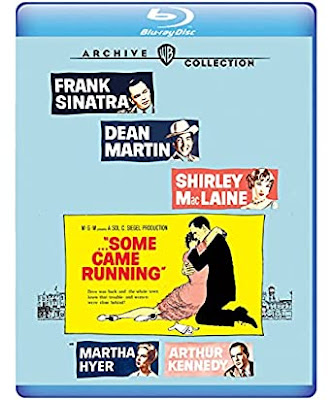
On Blu-Ray: Frank Sinatra, Shirley MacLaine and Dean Martin in Vincente Minnelli's Some Came Running (1958)


Going into Some Came Running (1958), I anticipated the steamy small town melodrama portrayed in the film’s trailer. It promised piano-pounding passion and a repressed mid-century society bursting from within. Perhaps it could have been about that, but in director Vincente Minnelli’s hands, James Jones’ (From Here to Eternity) massive tome evolved into something more sensitive and insightful, if still pulsating with the excitement promised in its marketing. This often somber, but engrossing Cinemascope production looks beautiful on a new Blu-ray release from Warner Archive.

Frank Sinatra stars as Dave Hirsh, a World War II veteran who reluctantly finds himself home in Parkman, Indiana. He is accompanied, in a fashion, by Ginnie Moorehead (Shirley MacLaine) a gaudy, but sweet dame he picked up while under the influence. Saddled with unwanted female attention, he also attempts, and fails to avoid his wealthy and self-absorbed brother Frank (Arthur Kennedy). Dave’s frustrations ebb when he meets Gwen French (Martha Hyer) a repressed school teacher who admires the works of his long abandoned writing career.

There is nothing in the town’s high society for Dave; he finds more comfort in the less restrained company of cardsharp Bama Dillert (Dean Martin). Ginnie seems a natural fit in that world, but Dave finds himself drawn to Gwen. In the midst of it all, just about everyone in the town misbehaves in one way or another, which makes it especially rich when Dave’s criticized for his drama simply because it’s published in the town paper instead of hidden behind doors.

While I find Sinatra’s restrained performance admirable, this film is stolen by MacLaine, with an assist by Martin. Minnelli seems to know this in the way he frames his scenes. Sinatra is always at his best with Martin, the shorthand of their friendship comes through on the screen and that is spotlighted with wisely balanced shots which feature both stars equally.

All of Minnelli’s sympathy goes to Ginnie though. His camera always seems to be checking in on her, framing her in windows, watching her adoringly as she peers through a classroom doorway. It is as if he wants to protect her, particularly from the toxic men in her life. She is the most vulnerable to the bad behavior that inevitably emerges when the males around her become adrift and insecure.

It’s heartrending to watch Ginnie beg for Dave’s love, she doesn’t deserve his snobbery and it’s horrifying to realize he’s actually treating her better than the other men she’s known. With her cheeks blasted with streaks of hot pink blush and a bedraggled purse shaped like a stuffed animal hanging from her arm, she seems like a child trying to play at being an adult, but beneath that façade is the core of the movie’s wisdom. Sinatra seemed to know that, and he felt that his costar deserved her flowers; he even had a key scene of the film altered to increase the emotional power of her role.

The film looks great, thanks to Minnelli’s experience in helming colorful, big budget musicals. He uses those skills in an artful way here, with careful compositions that use color, light, and various structures for maximum emotional impact. You see what particularly made him a great filmmaker when he is separated from the genre brought him fame.

Special features on the disc include a trailer and the featurette The Story of Some Came Running, which offers interesting insight into the film and its times.

Many thanks to Warner Archive for providing a copy of the film for review.

Nov 15, 2021

On TCM--Dean Martin: The King of Cool

As a fellow introvert, I’ve always appreciated Dean Martin’s ability to balance a career in the public eye and life as a devoted family man with his need to separate himself from the rest of the world. Dean Martin: The King of Cool, explores these different facets of the legendary performer’s personality with a rich array of interviews and clips from his films, television shows, stage appearances, and home movies. 

The film begins with Dean’s laidback childhood in an Italian immigrant community in Steubenville, Ohio, where he enjoyed a warm family life and didn’t learn to speak English until he was 6-years-old. He gave up early on school and instead dove into youth boxing, though he quickly transitioned to singing. He sang as much as possible and his natural charm propelled him to the top and kept him there for the rest of his life. Martin excelled at everything he did: nightclubs, films, and television, with a seemingly effortless ability as a singer, actor, and comedian. 

Among the interviewees there are the obvious subjects: Martin’s daughter Deana and his former sister-in-law Anne Haren and people he worked with like Angie Dickenson, Florence Henderson, Norman Lear, and Barbara Rush. What’s fascinating is the inclusion of a younger generation of entertainers, like RZA, who aside from his deep pop culture knowledge, has an acute understanding of the Rat Pack camaraderie as the Wu-Tang Clan shared much of that kinship. 

There is a general consensus among those who knew him that there was a part of Dean he kept shut away from the world. He had a lot of love around him, but he also needed solitude and was known for being quiet and reserved. There are many who were hurt by that impulse and the film acknowledges that, though it doesn’t dwell much on the fallout. 

Martin’s public persona was unique in its off-kilter carelessness. It looks a little sloppy, but he has control. This approach was endlessly adaptable; it worked in his legendary chaotic partnership with comedian Jerry Lewis, in his association with the Rat Pack, and on his long-running television program. It takes intelligence to appear that carefree. The film captures the way he developed that instinct and how it blossomed in various mediums. 

There are haunting elements to the story. Dean’s first wife Betty McDonald was essential to his success, molding his manners and look in an indispensable way, but she suffered when his career took off. Her descent into alcoholism and depression is mentioned, but not explored, and then she disappears. Of course, the entertainment industry is full of disappearing, defeated wives. 

Overall, Dean Martin: King of Cool works because it floats on the fascination Martin inspired in all he encountered. That allure is at the core of this mysterious, genuine, and timelessly entertaining artist. 

Dean Martin: King of Cool will have its broadcast debut on TCM, November 19. 


Many thanks to TCM for providing access to the film for review.

Mar 2, 2017

On Blu-ray: Judy Holliday and Dean Martin Charm in Bells Are Ringing (1960)


Director Vincent Minnelli's Bells Are Ringing (1960) has its fans, but I've never felt this musical gets the love it deserves. Perhaps stars Judy Holliday and Dean Martin don't offer vocal or dancing pyrotechnics, but they are nevertheless perfectly suited to the genre, giving performances that are uniquely charming and laid back. Now available on Blu-ray from Warner Archive, I recently had the chance to revisit the jaunty tunes and lively humor of this irresistible film.

Holliday is Ella Peterson, an operator at the small-time Brooklyn answering service Susanswerphone. She is constantly irritating company owner Sue (Jean Stapleton), by becoming inappropriately involved with the customers. Ella can't help her big-hearted self: when she has a hot tip, she gives it; when she thinks a dentist should drop his practice and pursue his songwriting dreams, she uses her connections to make it happen. Her favorite customer is playwright Jeffrey Moss (Dean Martin), for whom she adopts the persona of a grandmotherly character he calls "Mom".

Of course the pair can't remain strangers forever. After logging plenty of time making dreams come true for her clients, Ella settles into finding her own happy ending. Her romance with Jeffrey, buoyed by a pair of amusing side plots, carries the rest of the film.

The score, with music by Jule Styne (Gypsy [1962], Funny Girl [1968]) and lyrics by Holliday's longtime friends and former stage mates Betty Comden and Adolph Green, is bouncy, lively and often seems more carefree than it really is. While Better Than a Dream and Mu Cha Cha are blithely joyful, the airy feel of I Met a Girl and It's a Perfect Relationship conceal a lonely vein of sadness. Just in Time is the one bonafide classic in the score; it's slick, jazzy tone is a perfect fit for Martin and Holliday adds wonderful eccentricity to this version. Perhaps the most moving moment though is Holliday's rendition of The Party's Over, which is melancholy enough on its own, but is downright tear-jerking when you realize that this is the star's last film and breast cancer would take her life only a few years later.

While many musical fans don't concern themselves too much with the bits between numbers, it's always nice when the comedy is as good as the production numbers. A bubbly supporting cast, with Stapleton as the exasperated standout, is a colorful counterpoint to the well-matched Martin and Holliday. Always funnier with somebody to play off of, the singer is greatly boosted by Holliday's warmly comic manner.

What a shame Judy Holliday didn't make more musicals; she is such a purely loveable star and music lifts her that much higher. Her unpretentious manner takes the air out of the snobs in Jeffrey's shallow showbiz crowd. Comic bits like a scene on a busy New York City crosswalk where Ella decides to introduce herself to some of the grim-faced people in the crowd, and her amusing turn as a bohemian in an underground club, all end up making the film longer and busier than it needs to be, but Minnelli keeps things moving and it is hard not to be greedy for more Holliday.

The Blu-ray is presented with sharp, clear sound and a good image that shows the bright hues of this typically plush MGM musical to nice advantage. Special features on the disc include a featurette, outtakes and alternate versions of musical numbers and a theatrical trailer.

Many thanks to Warner Archive for providing a copy of the film for review. To order, visit The Warner Archive Collection.