Showing posts with label Kay Francis. Show all posts

Dec 29, 2021

On Blu-ray: 1933 Double Feature Mary Stevens, M.D. and Dinner at Eight

I was fascinated by the differences between a pair of films from 1933 I watched recently on new Blu-rays from Warner Archive. One is the efficient Warner Bros. melodrama Mary Stevens, M.D., starring Kay Francis and a cast full of the snappy, sharp-witted players who brought the studio success in the early thirties. The other, Dinner at Eight, is a lavish production filled with the biggest names at MGM Studios, though the young Jean Harlow stole the whole movie from her more experienced costars. 

Mary Stevens, M.D. features one of Francis’ best performances. She’s a young doctor who sets up shop with her former classmate and close friend Don (an adequate Lyle Talbot). He quickly gets tired of fighting to keep their pediatric practice afloat and marries politician’s daughter Lois (Thelma Todd, underused, but always welcome) so that he can secure the wealth and position he wants to enjoy without working to attain it. Predictably, that doesn’t go well for him. 

At first, it seems that the film is going to be all about Mary trying to find patients who aren’t horrified by the prospect of a lady doctor. It quickly dips into melodrama though, with illicit love, babies born out of wedlock, and deadly disease all complicating her life. It could be silly, but Francis is so sincere and as her nurse sidekick, Glenda Farrell keeps things zipping along when they could get maudlin. The film is particularly pre-code in the way the characters view Mary’s troubles with sympathy instead of scolding her for her sins, though it could be argued she is punished for her indiscretions.

My perspective of Dinner at Eight has changed dramatically over the years. Jean Harlow has been the one constant. As the fabulous-tacky nouveau riche Kitty Packard, she overshadows her illustrious cast mates, among them Billie Burke, Lionel Barrymore, John Barrymore, and the beloved Marie Dressler. Her crackling comic performance makes me constantly forget that this film is as much a drama as a comedy. 

Over the years, I’ve overcome the disorientation that comes from the intense busyness the film evokes and honed in on other performances, like the charming resignation of Dressler as a former stage star with financial troubles and the mix of bravado and impotence in John Barrymore’s fading matinee idol (he has a moment of brave vulnerability where he actually whimpers like a child). Burke is also a shallow, oblivious delight, devastated by the increasing disaster her dinner party is becoming while life and death struggles unfold around the bubble of self-involvement in which she exists. Her transition to a more aware, mature perspective is remarkably believable; she keeps the high pitch of her social climbing persona, while just beneath the surface a new decency emerges. MGM stars Lionel Barrymore, Wallace Beery, Edmund Lowe, Madge Evans, and Karen Morley are also on-board with their best performances.

Reportedly Harlow and Dressler became close on set and had discussed starring together in a comedy. What a shame the older comedian died in 1934 and that never came to pass.

Many thanks to Warner Archive for providing a copy of the film for review.

Dec 11, 2018

Pre-Codes on DVD: Passion Flower (1930) and Hide-Out (1934)


When Warner Archive announced that it would no longer be releasing the Forbidden Hollywood box sets, I was concerned, despite the company’s claims that it would still offer a steady stream of pre-code releases. While I still miss the sense of discovery in wading through those sets, I have been satisfied with the films from the period that have been offered since, including an interesting pair of new-to-disc flicks. I’d never even heard of Passion Flower (1930) and Hide-Out (1934) before their recent DVD release, so I approached both cold, with varying results.

Passion Flower (1930) is a standard melodrama: all about the varying degrees of suffering its characters endure. It stars two Kays: Ms. Johnson as a wealthy girl who marries her chauffeur (Charles Bickford) and is disowned by her father, and Ms. Francis as her so-called friend who first offers financial help, but then decides she wants to help herself to her friend’s hubby. By then there are children in the mix, so her selfishness is especially cold-hearted.

This was one of the films where Kay Francis set the template for two key aspects of her persona: the dangerously sexy husband thief (see also A Notorious Affair [1930]) and the ever suffering glamour puss (Mandalay [1934]). Here she only imagines herself the victim though. Even among the pre-code stars, only Kay Francis could feel sorry for herself for stealing another woman’s husband.

Francis is essentially the reason to watch; Johnson and Bickford aren’t nearly as intriguing, at least partly because they don’t have much to work with. As the oldest son of the pair, pre-Rascals Dickie Moore is reliably adorable and keeps his parents in line with his tiny pout and seal eyes. Zasu Pitts is also a bright spot as a tender-hearted landlady. It isn’t a production of distinction, but everyone is playing reassuringly to type.

Hide-Out (1934) could have been a standard fish-out-of-water yarn, but its cast and the staging of the production give it life beyond its familiar plot. Robert Montgomery plays a womanizing New York gangster-lite party boy who gets himself in trouble with the law. He escapes to an isolated farmhouse, where he is quickly charmed by his hosts, the wholesome Miller family, and falls in love with their daughter (Maureen O’Sullivan).

Director W.S. Van Dyke keeps the action light and brisk, transitioning confidently from the busy nightclub scenes in the first part of the film to the homier farm scenes to follow. The juxtaposition of the two worlds is enjoyable, with lots of songs and dancing girls bringing life to the city milieu and young Mickey Rooney taking on the role of entertainer on the farm as the youngest of the Miller clan.

There’s a great cast at play here and they are all at the top of their game. Montgomery, O’Sullivan and Rooney are especially lively—as are Elizabeth Patterson as Mama Miller and Edward Arnold as a tough, but jovial police detective. They all seem to be enjoying themselves together, as if the feeling of a happy set is translating to the screen. The laughs are a little more genuine than in a similar production and the relationship between O’Sullivan and Montgomery feels especially real as it develops from affection to love.

As I wondered where this surplus of cast camaraderie came from, it occurred to me that Montgomery might have had something to do with it. I thought about the way he always brought a little extra fire out of Norma Shearer in the romantic comedies they did, and how even playing an utterly evil character as he did in Night Must Fall (1937), he remained completely charming and infused the rest of the cast with his electricity. It’s something worthy of more thought: The Montgomery Effect. I’ve always thought he was underrated; now I’m thinking his appeal was also influential for his costars.

Many thanks to Warner Archive for providing copies of the films for review. These are Manufacture on Demand (MOD) DVDs. To order, visit The Warner Archive Collection.

May 24, 2018

On DVD: 5 Pre-Codes from Warner Archive


I love it when Warner Archive releases a flood of pre-codes. It almost makes up for the end of the Forbidden Hollywood box set series--almost. The company has thankfully stayed true to its promise to continue to make films from this era available on DVD. I enjoyed this latest batch, which includes a pair of flicks starring Ronald Coleman, early Kay Francis and Loretta Young talkies, and a good mix of genres.

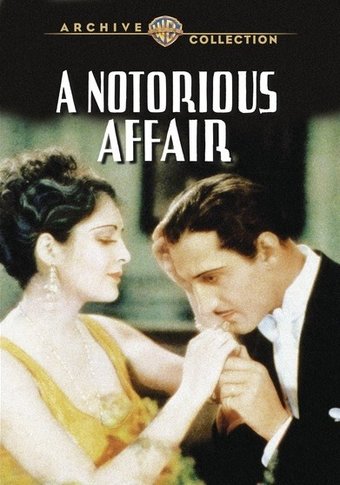
A Notorious Affair (1930) is an unusual melodrama in that it features Kay Francis, but stars Billie Dove in what would eventually be the standard Francis role. Dove is a young heiress who falls in love with an impoverished musician (Basil Rathbone) and leaves her wealthy enclave for a more humble life. Rathbone falls for his thrill seeking patron, the Countess Balakiereff (Francis), causing Dove heartbreak and falling into ill health himself.

After watching Francis suffer nobly through so many melodramas, it is fun to see her be bad. With her slicked back bob and dangerous smile, she is the type to cap a flirtation with an attractive specimen below her balcony by tossing down her keys. I would have loved to have seen her in more roles like these, because it looks like she’s having a blast.

It’s rough to watch the usually dashing and devilish Rathbone play a weak and whiny character, though he does possess some consumptive glamour. Dove seems to think she deserves him, though she has better prospects. Still, despite her faulty romantic radar, she suffers elegantly, with those big eyes and a delicate bird beak nose that points down just so.


The Ship From Shanghai (1930) begins with a jaunty Chinese ensemble playing Singin’ in the Rain in a Shanghai nightclub. It’s about the last light moment in this tense flick that all but creates the template for many a shipbound terror flick.

Wealthy Conrad Nagel and and Kay Johnson join a group from their set on 3-month yacht voyage across the Atlantic. There they are eventually held captive by the vengeful ship steward (Louis Wolheim) and crew, who despise the snooty passengers and their high-handed ways. Of course, the truth is the steward only longs to be a part of their world, a fact made clear when he puts the moves on Johnson.

The film takes a sharp dive from playful luxury, to sweaty, nasty horror. You spend the first part of the film observing the off-putting privileged passengers and the next repulsed by Wolheim and his men. It isn’t enthralling drama, but it serves its purpose as a solid entertainment and keeps a good pace through its 67 minute running time.


The Devil to Pay (1930), stars Ronald Coleman as an irresponsible playboy attempting to bounce back from his careless loss of another chunk of his father’s fortune. Cut off from the family coffers, he returns to his mistress, but soon abandons her for a young heiress. This airy set-up then begins to deflate, as the necessary romantic conflict is something more easy to resolve than the plot would have it.

The film features a teenage Loretta Young as the heiress and Myrna Loy as Coleman’s actress mistress in a rare early role where she doesn’t play an Oriental temptress. As Coleman’s love interests, the effect they have varies widely. While Loy is charming and more age-appropriate for her male lead, she hasn’t yet honed the edges of the sharply appealing persona that would be the cornerstone of her legend. On the other hand, Young seems to have arrived in the talkies with her image fully-formed, if a bit coltish.

Coleman is reliably elegant and mischievous in a role that John Gilbert could also have mastered with ease. It’s a fun romp, enjoyable because for most of the running time you get the simple enjoyment of watching these attractive people at play.


Condemned (1929) also headlines Ronald Coleman, this time as a prisoner on Devil’s Island. Upon his arrival on a tightly-packed ship, he and his fellow prisoners are told there is not escape, upon which he turns to wink at his friend (Louise Wolheim). The warden (Dudley Diggs) observes Coleman’s elegant manner and decides to put him to work for his wife (Ann Harding) in their home.

The pair hit it off right away, establishing a friendly rapport. They are two attractive people though, and the inevitable happens: Coleman buys Harding a monkey in the market, inflaming her passions and Diggs’ envy. The pair plan to escape together, with the help of  Wolheim (he's one of those bruisers with a big heart and a delightfully smooshed nose).

Coleman and Harding have a solid, if not sizzling, chemistry and the action moves along efficiently. While much of the story runs along familiar lines, there are a few good jolts away from predictability.

Of the films reviewed here, Condemned has the most notable wear and tear, with lots of hiss and popping on the soundtrack, though the image is for the most part clean and clear.


The best of the bunch is The Lost Squadron (1932), a post-World War I drama set in Hollywood. Upon release from the army, a quartet of American fliers (Richard Dix, Joel McCrea, Robert Armstrong, and Hugh Herbert) pledges allegiance to each other and their fallen countrymen, who they refer to as “the lost squadron.” Jobs are scarce, but alcoholic Armstrong finds success as a stuntman in the movies and eventually the other three find work alongside him.

Hollywood is no safe haven though, as Dix runs afoul of a sadistic director (Erich von Stroheim). The men find themselves faced with an enemy more deadly than any they ever faced in wartime. Mary Astor and Dorothy Jordan are the women in their lives, and while this is an emphatically male-driven film, these actresses have a powerful presence.

The Lost Squadron has an unusually vibrant soundscape for an early talkie, drawing much of its drama from eerily rushing wind, whistling, and the shifts between quietly eerie or contemplative scenes and more raucous, celebratory moments. It is this high level of craft, and the charisma of the varied cast which make this an unsung gem worthy of classic status.

Many thanks to Warner Archive for providing copies of the films for review. These are Manufacture on Demand (MOD) DVDs. To order, visit The Warner Archive Collection.

May 11, 2018

On DVD: Kay Francis in Comet Over Broadway (1938)


No actress gave the classic melodramatic weeper more depth than Kay Francis. In a genre crafted to manipulate emotions, she threw herself into the drama with such abandon that you can’t help forgiving her for working your tear ducts so relentlessly. Now on DVD from Warner Archive, Comet Over Broadway (1938) showcases the actress at her glamorous, self-sacrificing best.

Francis plays an ambitious newsstand worker who lives with her husband and baby daughter. She spends her days reading Variety and her nights performing in community theater, always dreaming of big stage success. When her husband accidentally kills a visiting famous actor who he suspects of putting the moves on Francis, he is put in prison for life.

Determined to get her man out of jail, the guilt-ridden Francis hits the road with her daughter, working her way up from carnival entertainer to Broadway star. Along the way she meets an aging actress on the verge of retirement. She notes the trouble Francis has raising a child on the road and insists that she take on the task of raising the young girl. Though reluctant to part with her, she agrees that it is the best for her daughter.

As the years pass, Francis falls in love, reunites with her daughter and fights for her husband. She is criticized for her ambition and her poor mothering, but is nevertheless determined to do things her own way. There are syrupy strings, eyes full of tears always on the brink of falling, and sacrifices galore.

Sybil Jason plays Francis’ daughter. It’s her second pairing with the actress, they were also mother and daughter in I Found Stella Parish (1935). As in that film, they have a pleasing chemistry, playing off each other well in some of the film’s most emotionally wrenching scenes. Jason was groomed to be a sparkling Shirley Temple type, but she was more appealing as a dramatic star, always approaching her roles with sincerity and genuine warmth.

Bette Davis rejected the lead of Comet Over Broadway because she felt it was beneath her, which is fair, it was. However, in Francis’ hands this is a perfect melodrama. She knew exactly what she was doing in this kind of film and in her way she is just as good as Davis because, like her, she knew her lane and she kept in it.

Few genres are more derided that melodrama, but if it is done well, it essentially thrives in its own universe. It is a heightening of reality, grabbing directly for your emotions and if it is the ride you want to take, Comet Over Broadway is the perfect expression of the form.

Many thanks to Warner Archive for providing a copy of the film for review. This is a Manufacture on Demand (MOD) DVD. To order, visit The Warner Archive Collection.

Aug 4, 2016

On DVD: Deanna Durbin and Kay Francis in It's a Date (1940)


As a Kay Francis and Deanna Durbin completist, I was delighted to see the pair starring in the recent Warner Archive release of It's a Date (1940), which is making its DVD debut. The first of four films Durbin would make with director William Seiter at Universal Studios, it's a breezy, charming little flick.

Francis is Broadway musical star Georgia Drake and Durbin is her adoring daughter Pam, who wants to follow in her mother's footsteps. After securing a promising new part written by playwright Karl Ober (S.Z. "Cuddles" Sakall in his Hollywood film debut), Georgia travels to Hawaii to rest and prepare for her role. However, while she is gone Pam impresses Ober with her dramatics and he decides she is a more appropriate age for the part. She doesn't realize she has won the role away from Georgia.

Hoping to get acting guidance from her mother, Pam takes a ship to Hawaii. On board she meets millionaire John Arlen (Walter Pidgeon), and mistakes his attempts to lighten her mood for blossoming love. When she arrives in Hawaii, Pam learns the truth about the part, and plans to quit acting and marry John, who has quickly fallen for Georgia. There are many misunderstandings, but of course not anything these three can't handle.

While It's a Date is the best of her work with Seiter, who also made several musicals with Shirley Temple, it falls somewhere in the middle of her filmography overall, more amusing than her later movies, but not quite as slick or witty as earlier efforts like First Love (1939) or It Started With Eve (1941) the following year.

Durbin and Francis have an intriguing chemistry. They don't seem like mother and daughter, maybe more like sisters, but they exude the easy intimacy of a strong family relationship. Durbin found a similarly warm, and even more profound onscreen connection with Charles Laughton in Eve. She had a knack for making her costars seem to be at ease, which also extends to Pidgeon, who seems at ease in a looser, less dramatic part than the kind he would play later in his career.

While an unadorned soprano voice was Durbin's ticket to fame, she has presence beyond her musical ability. The scenes between songs could have stood alone as a solid comedy. Still, watching her croon Love is All to her beaming mother or moving an audience as she stands motionless singing a flawless rendition of Ave Maria is mesmerizing. Durbin didn't need elaborate production numbers or costumes to cast a musical spell.

The picture quality is essentially good, but low for a Warner Archives release. There are some noticeable lines and scratches, some that stay on the image for several minutes. The sound also seemed a bit scratchy at times. These issues are not likely to be deal breakers for Durbin fans eager to own this enjoyable film on DVD.

Many thanks to Warner Archive for providing a copy of the film for review. This is a Manufacture on Demand (MOD) DVD. To order, visit The Warner Archive Collection.

Sep 11, 2015

On DVD: The Lighter Side of Kay Francis in The Feminine Touch (1941)


After all melodrama I sniffled through in the pair of Francis flicks I reviewed earlier this week, I needed something lighter, and I got it with The Feminine Touch (1941). Francis takes a supporting role in this comedy about jealousy in romantic relationships now available on DVD from Warner Archive.

Don Ameche stars as a college professor who has been burning the midnight oil finishing his book, Jealousy and All Its Aspects and Universal Applications. As much as he seems to know about this disruptive emotion, he doesn't appear to feel it himself, much to the irritation of his wife (Rosalind Russell), who would like a bit more possessiveness in her man.

When Ameche's frustration with his university position drives him to quit, the pair takes off for New York to meet the publisher (Van Heflin) they hope will publish the now former professor's book. This pointy-bearded Don Juan and his sharp-witted assistant (Francis), give the couple a lot more field experience in what it is like living with the green-eyed monster.

The four are an amusing trio, though I always felt as if something wasn't quite working among them. Part of the problem is that Ameche,while very charming, is not nearly as dynamic as his costars. His chemistry with Russell is also a bit off, but then, I never thought he was brilliant in an onscreen pairing until he teamed up with Ralph Bellamy in Trading Places (1983).

Heflin charms everyone else off the screen, as he normally does, and Russell is full of her typical snap. Francis is more of a revelation, she is as beautiful and perfectly groomed as audiences expected of her, but backs that up with good timing and a light comedic touch.

One of Ms. Kay's astonishing hats

This is a solidly pleasing production: the costumes and sets are impeccable in that lush, MGM way and Francis and Russell get plenty of opportunities to look smashing in ridiculous hats that would destroy most ordinary women. The attempted seductions and misunderstandings can threaten to become tiring, but there's always a snappy line or a twist on convention that rescues the scenes that begin to flag.

After spending most of her career suffering in dramatic gowns, Francis seems to be enjoying jumping into a lighter role. She approaches her biting lines with gusto, seemingly less focused on suffering prettily, and relishing the chance to show off her comic chops. Though pre-code Kay will always be my favorite, her maturity here is appealing.

Though The Feminine Touch is often more amusing that funny, the last sequence is a hilarious bit of slapstick that is both original and incredibly silly, and elevates all that came before. It's a bright finale for an unusual, and essentially enjoyable comedy.

Many thanks to Warner Archive for providing a copy of the film for review. This is a Manufacture on Demand (MOD) DVD. To order, visit The Warner Archive Collection.
Sep 9, 2015

On DVD: Kay Francis in I Found Stella Parish (1935) and Confession (1937)

Image

There is no movie genre that makes me ugly cry more profusely than the maternal sacrifice melodrama. Perhaps Barbara Stanwyck has played the most famous of these mothers in Stella Dallas (1937), where she stood in the rain, an outcast, looking through the window at her daughter's wedding, eyes glimmering with proud tears, but Kay Francis more than made her mark as a suffering mama. In a pair of new releases from Warner Archive, the actress suffers nobly and jerks tears relentlessly. If that sounds unbearable, it isn't. These are well-paced, entertaining dramas.


In I Found Stella Parish (1935), Francis is a celebrated London stage actress who is also mother to a charming six-year-old played by Sybil Jason. When a blackmailer threatens to reveal an unpleasant incident from her past, she goes incognito and slips away with her daughter to the States. Her cover is blown by a curious reporter (Ian Hunter) who realizes too late that he wants to help, not expose the actress.

Of course one of the most important elements of a good maternal sacrifice flick is the child. After all, there is no tension if the kid doesn't seem worth the fuss. Francis has a charming chemistry with Sybil Jason, who is adorable, but not so precocious that she steals the spotlight from her leading lady. The South African actress had been imported from her British home to be the Warner Bros version of Shirley Temple. While she doesn't quite have Temple's sparkle (and who did?), she's an appealing actress, wide-eyed, earnest and not too cloying.

Francis had an interesting ability to manipulate her audience. When her eyes become wide with grief and fill up with tears, she is clearly playing on your emotions, but the actress never comes off as too melodramatic or silly. You can see her acting, but you can also see how her heart is hurting, and it is devastating. As Stella Parish she uses all her tricks, moving efficiently through her troubles, but always with great heart and warmth.


Confession (1937) reteams Francis with Hunter as a husband and wife whose happiness is threatened by the concert pianist (Basil Rathbone) who conducted her in her successful career as an opera singer, and who is still determined to possess her. He forces a scandal through which Francis is divorced and forced to leave her daughter with her father.

Francis barely exists as a singer in cheap clubs, always searching for her child. Soon after she finds her, she discovers the teenager kissing the very pianist who destroyed her life. Unable to bear the degradation of her daughter, she kills him. The trial that follows is grueling for the singer, and not due to fears of her own fate, but because she wants to spare her daughter from the public shame of learning of her past in the courtroom.

I've never seen Francis' glamour more thoroughly trashed in a film. At first, efforts to make her look sleazy are only somewhat successful. Plastered with heavy make-up and sporting a curly Harpo wig, she somehow still comes off as lovely and statuesque, if gaudy. By the trial scene she finally looks thoroughly ravaged, though her look would still gain her some cred in the Goth crowd.

All this deglamorizing was perhaps an attempt to make something more of Francis than her well established reputation as a gorgeous, suffering clotheshorse. However, with or without the glitz, she was always able to communicate the greater depths beneath her beauty. Francis may not have had the fire of contemporaries like Davis and Stanwyck, but she was always a pleasure to watch; she had her own, unique power, a sort of tenderness propped up by a steel backbone. 

In the moving final scene of Confession, a simple special effect is used to communicate the emotion beneath Francis' controlled appearance. The gentleness and wisdom with which she approaches that moment is all her own. Though she never had a child herself, the actress effectively demonstrates the maternal pull, and how it can inspire great sacrifice.

Many thanks to Warner Archive for providing a copies of the films for review. These are Manufacture on Demand (MOD) DVDs. To order, visit The Warner Archive Collection.

May 16, 2015

Apr 11, 2015

Aug 24, 2014

Quote of the Week


She had a huge amount of charisma. You have no idea. She walked into that room and you could feel her energy. You could just feel it. It was kind of overwhelming.

-Margalo Ashley-Farrand about Kay Francis. She met her at age four, when the actress was having an affair with her father.

Quote SourceImage Source