Showing posts with label Mickey Rooney. Show all posts

Jan 26, 2022

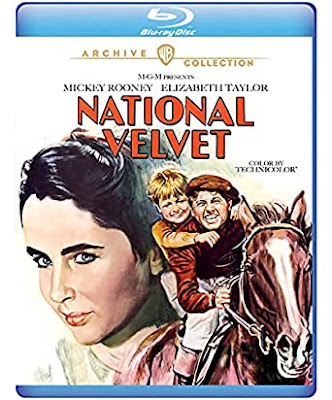
On Blu-ray: Young Elizabeth Taylor in National Velvet (1944) and Ivanhoe (1952)


 I’ve always felt like Elizabeth Taylor doesn’t get enough credit. Attention and admiration yes, but not enough praise for the variety she managed in her career. She was unique in the way she triumphed as a child actress and then moved through her teenage years gracefully before progressing to a higher level of acting and winning the greatest praise her industry had to offer. I thought about this as I watched a pair of new Warner Archive Blu-rays featuring the star in two early films: National Velvet (1944) and Ivanhoe (1952). 

Taylor showed the special passion for life that would fuel her many triumphs in her breakout performance as the horse-obsessed Velvet Brown in National Velvet. She glows with enthusiasm, entirely unable to show any teenage gawkiness despite the metal brace plate she keeps clicking in and out of her mouth. 

As a young rider who masquerades as a boy to compete in the Grand National Steeplechase, she emulates the strength of her mother (Anne Revere), a former champion swimmer who has a glint in her eye that implies a past of wild times behind her calm, maternal façade. As drifter and former jockey Mi, Mickey Rooney guides Velvet to the top, showing her the ropes when his initial impulse to take the race entry money and bolt is trumped by her infectious enthusiasm. This was the first time I tapped into Rooney’s talent. I never understood why he was so beloved until I saw him here, working in a lower-key register, revealing depths that could never come out in a musical. 

The rest of the cast is full of actors that always bring a smile; they’re like visual comfort food. There’s a young and pretty Angela Lansbury as Velvet’s sister and the always reliable Donald Crisp as the Brown patriarch. Freckle-faced, gap-toothed, sleepy-eyed Jackie “Butch” Jenkins is also there as Velvet’s brother, stealing scenes as he always does. 

I always find the middle part of the film drags, but the final race scene offers enough excitement to make up for the slack. Overall it’s a great tribute to the worth of taking risks simply because it makes you feel more alive. 

The sole special feature on the disc is a theatrical trailer.
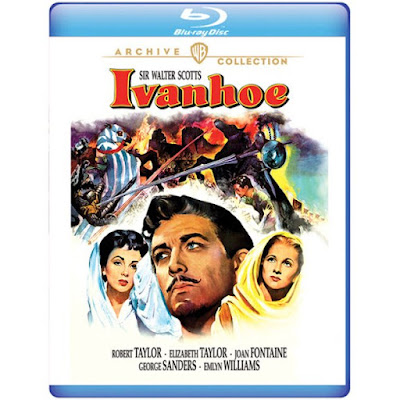
While I am not generally a fan of period pictures like Ivanhoe, I find this production objectively pleasing. It is filmed in bold, beautiful color, the stars, costumes, and sets are attractive, and there are some decent action scenes. 

In the title role Robert Taylor is pretty, but bland. In one of his standard villain roles George Sanders is more exciting, though it’s creepy to see him put the moves on a young Elizabeth Taylor as a Jew who loves and strives to protect Ivanhoe. Her romantic rival is Joan Fontaine, who has almost nothing to do but look lovely. 

Taylor’s role is not much more substantial. While this is a movie of men, she can’t help but have a little steel behind her words, though she has clearly been directed to look passive and pretty. After the fire of youth roles like National Velvet, it’s hard to see her playing such a bland character, but she already had A Place in the Sun (1951) under her belt and more engrossing films were yet to come. 

The jousting scenes in the final portion of the film are the most rousing part of the action, with more thrills than any of Ivanhoe’s romantic life. 

Special features on the disc include the Tom and Jerry cartoon The Two Mouseketeers and a theatrical trailer.


Many thanks to Warner Archive for providing a copy of the film for review.

Sep 2, 2020

On Blu-ray: A Garland and Rooney Double-Header, Strike up the Band and Girl Crazy


When I finished up my double feature viewing of the Judy Garland and Mickey Rooney films Strike up the Band (1940) and Girl Crazy (1943) (both newly available on Blu-ray from Warner Archive), I felt a familiar mixture of exhilaration and confusion. There’s so much to love about these classic musicals: the top-shelf tunes, entertaining supporting cast, uplifting production numbers designed by Busby Berkeley, and the transcendent marvel that is Judy Garland. 

The everlasting point of confusion for me is Mickey Rooney. I wonder how many classic film fans appreciate Mickey Rooney more than they enjoy him? It’s clear that he had talent; I’m not entirely immune to his zest, but don’t think I’ll ever get him completely. I’m sure part of it is that some of his humor and vigor haven’t aged well, but it’s also hard for me to pay him much mind when Garland is there busting your heart open with those smooth tones and soulful brown eyes. He seems like a cheerful wind-up toy in comparison.

That confusion has always affected my feelings about Garland and Rooney films. They have an undeniable chemistry, but I’m always baffled that the miraculous Ms. Judy would be mooning over this self-absorbed, oblivious guy. I know it is very much of the times that she sits there cheering him on while sitting on her own monster talent and intellect, but knowing isn’t everything. 

I suppose it says a lot for these films that despite all that, they always leave me happy. Strike up the Band is rightfully most famous for a dream sequence that features an orchestra of stop-motion figures with fruits and nuts for both their heads and instruments. The moment is the product of aspiring band director Jimmy’s (Rooney) imagination: he is using the contents of an overflowing fruit bowl to explain his musical plans to his friend Mary (Garland). The scene is full of bizarre images, like a walnut-headed figure playing a nutcracker like a harp and a line of pear-noggined musicians playing pear halves like violins. An early career George Pal designed the number, which could stand on its own as an entertaining short film. 

This unusual scene happens early in a musical that is otherwise full of that “let’s put on a show” vigor. Thanks to Berkeley, the dance numbers really pop. His standard technique of using dancers to make mesmerizing patterns gets a burst of energy from his youthful dancers. They’re all adorable, though it is really something seeing all those white kids attempting Cuban flair in the Do the La Conga! number. 

The then hugely popular bandleader Paul Whiteman (most famous now for his key role in King of Jazz [1930]) appears with his orchestra and even acts opposite Rooney in a few scenes. 


Though it also has its share of big production number flair, Girl Crazy (1943) is for the most part a lower-key affair. This is my favorite Rooney and Garland film because it is bursting with Gershwin standards. Having But Not for Me, I Got Rhythm, and Embraceable You in one movie would be enough to give it classic status, but the topper is the magnificently meandering Bidin’ My Time, with Garland and the The King's Men and chorus, and is practically an anti-production number with its easy pace and lanky cowboy dancers. 

I also enjoyed the presence of character actor Rags Ragland, who shows his burlesque past in the way he adapts smoothly and easily to the performance style of his costars. He had an especially pleasing chemistry with Garland.

Tommy Dorsey and his band are lively presence throughout the film. Director Norman Taurog perfectly frames the fresh, joyful energy of the trombonist and his musicians. The group plays for June Allyson in the opening nightclub number as she croons Treat Me Rough. They are especially magnetic though in the Fascinating Rhythm number, where they all look like they are having the time of their lives.

Both discs feature introductions by Mickey Rooney and theatrical trailers. Strike up the Band also has a commentary by John Frick, the comedy short Hollywood Daredevils, the cartoon The Early Bird Dood It, a Stereo remix of I Got Rhythm, and audio of a Bronco Busters outtake. The Girl Crazy disc includes the Pete Smith comedy short Wedding Bills, the cartoon Romeo in Rhythm, a Stereo remix of Do the La Conga, and audio features including a Leo is on the Air Radio Promo, Millions for Defense and a 1940 Lux Radio Theater Broadcast. 

Many thanks to Warner Archive for providing copies of the films for review. To order, visit The Warner Archive Collection.