Showing posts with label Elizabeth Taylor. Show all posts

Jan 26, 2022

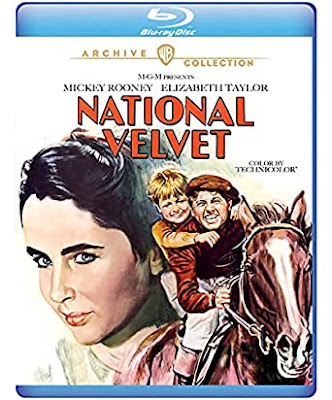
On Blu-ray: Young Elizabeth Taylor in National Velvet (1944) and Ivanhoe (1952)


 I’ve always felt like Elizabeth Taylor doesn’t get enough credit. Attention and admiration yes, but not enough praise for the variety she managed in her career. She was unique in the way she triumphed as a child actress and then moved through her teenage years gracefully before progressing to a higher level of acting and winning the greatest praise her industry had to offer. I thought about this as I watched a pair of new Warner Archive Blu-rays featuring the star in two early films: National Velvet (1944) and Ivanhoe (1952). 

Taylor showed the special passion for life that would fuel her many triumphs in her breakout performance as the horse-obsessed Velvet Brown in National Velvet. She glows with enthusiasm, entirely unable to show any teenage gawkiness despite the metal brace plate she keeps clicking in and out of her mouth. 

As a young rider who masquerades as a boy to compete in the Grand National Steeplechase, she emulates the strength of her mother (Anne Revere), a former champion swimmer who has a glint in her eye that implies a past of wild times behind her calm, maternal façade. As drifter and former jockey Mi, Mickey Rooney guides Velvet to the top, showing her the ropes when his initial impulse to take the race entry money and bolt is trumped by her infectious enthusiasm. This was the first time I tapped into Rooney’s talent. I never understood why he was so beloved until I saw him here, working in a lower-key register, revealing depths that could never come out in a musical. 

The rest of the cast is full of actors that always bring a smile; they’re like visual comfort food. There’s a young and pretty Angela Lansbury as Velvet’s sister and the always reliable Donald Crisp as the Brown patriarch. Freckle-faced, gap-toothed, sleepy-eyed Jackie “Butch” Jenkins is also there as Velvet’s brother, stealing scenes as he always does. 

I always find the middle part of the film drags, but the final race scene offers enough excitement to make up for the slack. Overall it’s a great tribute to the worth of taking risks simply because it makes you feel more alive. 

The sole special feature on the disc is a theatrical trailer.
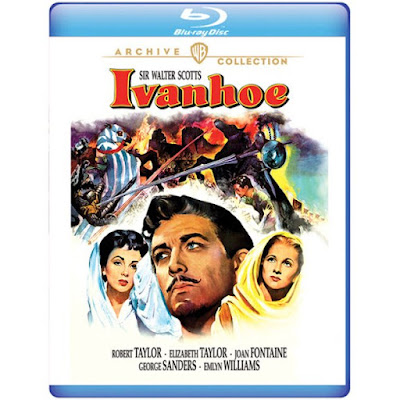
While I am not generally a fan of period pictures like Ivanhoe, I find this production objectively pleasing. It is filmed in bold, beautiful color, the stars, costumes, and sets are attractive, and there are some decent action scenes. 

In the title role Robert Taylor is pretty, but bland. In one of his standard villain roles George Sanders is more exciting, though it’s creepy to see him put the moves on a young Elizabeth Taylor as a Jew who loves and strives to protect Ivanhoe. Her romantic rival is Joan Fontaine, who has almost nothing to do but look lovely. 

Taylor’s role is not much more substantial. While this is a movie of men, she can’t help but have a little steel behind her words, though she has clearly been directed to look passive and pretty. After the fire of youth roles like National Velvet, it’s hard to see her playing such a bland character, but she already had A Place in the Sun (1951) under her belt and more engrossing films were yet to come. 

The jousting scenes in the final portion of the film are the most rousing part of the action, with more thrills than any of Ivanhoe’s romantic life. 

Special features on the disc include the Tom and Jerry cartoon The Two Mouseketeers and a theatrical trailer.


Many thanks to Warner Archive for providing a copy of the film for review.

May 19, 2021

Book Review--Elizabeth and Monty: The Untold Story of Their Intimate Friendship


Elizabeth and Monty: The Untold Story of Their Intimate Friendship 
Charles Casillo 
Kensington Books, 2021 

Elizabeth Taylor and Montgomery Clift had an unusual connection, particularly for Hollywood: a lasting, loyal friendship as intimate as a marriage, which endured throughout decades. In Elizabeth and Monty: The Untold Story of Their Intimate Friendship, Charles Casillo tells the story of their lives and how they supported each other through the best and worst of times. 

Taylor and Clift met while making the George Stevens film A Place in the Sun (1951). Elizabeth was a teenage MGM player, while Monty was at the time a bigger star and more seasoned as an actor. He taught her that acting was something to take seriously, but there was also an immediate, visceral connection between the two. For her it was passionate love, but eventually he made it clear that he would always prefer men sexually, though he deeply connected with women emotionally. 

The friendship that began on that production would last until death parted them, their loyalty to each other unaffected by distance, scandal, poor health, and the myriad disappointments that can complicated a life. They would make two more films together: Raintree County (1957) and Suddenly, Last Summer (1959), the latter due to Taylor’s instance that a troubled Clift be cast. Casillo explores the way their relationship changed, from Elizabeth’s early desire for Monty to the more enduring, soulful friendship that developed over the years. 

Much of the story here will be familiar to fans of Taylor and Clift. Casillo draws heavily on Patricia Bosworth’s Clift biography and Kitty Kelley’s biography of Taylor. Aside from these more familiar sources, there are some interesting tidbits; I especially appreciated the insight from director Edward Dmytryk’s unpublished manuscript The Making of Raintree County, which reflects a critical time in Monty’s life and in his relationship with Elizabeth. 

Of the first source interviews included in the book, the most revealing and touching memories come from actor Kevin McCarthy, who with his wife Augusta Dabney was a close friend of Clift’s, though the couple had to withdraw from him to a degree as his behavior became more dangerous and erratic. McCarthy’s point of view is important, because he was present for many of the key points of Clift’s life, from his start on the stage in New York, to the decline of his Hollywood career. Most importantly, he was a guest at Elizabeth Taylor’s house and was driving ahead of Clift down a twisting hill on the night he crashed into a tree, changing his face and his life. 

The book leans heavily into the sex and scandals in Taylor and Clift’s lives, seeming to squeeze every last bit of sensation out of those elements. While these are important and even formative moments in their story, the degree to which they were lingered upon felt excessive. 

I found the details of Elizabeth and Monty’s interactions more compelling. Their relationship was a fascinating combination of devotion and selfishness, tough love and absolute acceptance. While it was pure love that kept them close over the years, it is clear that a mutual understanding of the complexities of human relationships helped them through the rough spots. In the end, I saw their connection with more clarity and better appreciated how unusually strong their bond was. 

Many thanks to Kensington Books for providing a copy of the book for review.

Aug 12, 2020

On Blu-ray: Reflections in a Golden Eye (1967), Sweet Bird of Youth (1961), and Inside Daisy Clover (1965)


I recently had a personal viewing party full of dysfunction thanks to a trio of new Blu-ray releases from Warner Archive. Inside Daisy Clover, Reflections in a Golden Eye, and Sweet Bird of Youth are a messy, but fascinating trio cataloging the many ways being a human can go off the rails.

Reflections in a Golden Eye (1967)

With his typical respect for the work of great novelists, director John Huston filmed friend Carson McCullers’s second novel with the plot essentially intact. This story of illicit passions and mental strife on a southern army base has drawn a few laughs over the years for its over-the-top dramatics, but I’ve always thought the high temperature of many of the performances suited the characters.

As the foursome at the center of the film, Marlon Brando, Brian Keith, Julie Harris, and Elizabeth Taylor are a well-balanced quartet of contrasting vigor and frailty. Taylor in particular seems to understand the psychology of the dim-witted, but emotionally blazing woman she plays. In a calm, nearly wordless performance, Robert Forster cools the proceedings, thought his chill is clearly only on the surface. Richard Burton, Montgomery Clift had both circled Brando’s role, but I can’t imagine anyone but him capturing the mixture of bluster and shame necessary to play an officer who craves control, but can’t even get a handle on his own desires.

One of the best features on the disc is the option of watching the film in standard color as released or with a wash of gold as Huston had originally planned. I like both versions, but the golden hue is effective in making these characters seem trapped in their uncomfortable, insular world, like fish circling a dirty bowl. The disc also includes a short film of silent behind-the-scenes footage, which documents what appears to be a pleasant, professional set in total contrast to the turmoil of the drama being portrayed.


Inside Daisy Clover (1965)

Natalie Wood was under contract to Warner Bros when she won the lead in Columbia Picture’s Inside Daisy Clover. The studio forced her to star in The Great Race (1965) in exchange for doing the film, which reinforced why playing a juvenile film actress who suffers under the control of her employers would have appealed to the actress. She also recognized Daisy’s isolation.

It’s a bleak film. Daisy Clover (Wood) rises from poverty, but doesn’t escape her suffering. Every time she thinks she has found love and affection, be it from her mother (Ruth Gordon), a lover (Robert Redford), or her employer (Christopher Plummer), it is cruelly taken away from her. Daisy needs to learn to love herself, but she’ll need to move through a lot of emotional clutter to understand that.

Wood is at her best in her scenes with Gordon and Redford. She insisted on casting her friend Gordon as her mother and their closeness comes through on screen. In the first of two movie pairings with Redford, she found one of her best costars. They relax with each other in the most delightful way, as if they are at play.

Special features on the disc include a trailer for the film and the classic cartoon War and Pieces.


Sweet Bird of Youth (1961)

Based on the Tennessee Williams play, this production is packed with the passions and power struggles typical of the playwright’s best work. It centers on Chance Wayne (Paul Newman), a never-was in Hollywood who has returned to his small Mississippi hometown with the drug-addicted, alcoholic star Alexandra del Lago (Geraldine Page), to whom he has been serving as procurer and nursemaid, among other things. He pines for his childhood sweetheart Heavenly (Shirley Knight) though her corrupt political bigwig father Boss Finley (Ed Begley) is dead set against their reunion. Rip Torn is quietly frightening as his son and reptilian fixer.

Newman, Page, and Torn performed in the Broadway production of the play, and their familiarity with the material and each other gives the film an added emotional vibrancy. They could all be caricatures, but have lived with these characters long enough to view them with humanity. Begley earned his Best Supporting Actor Oscar for this performance; he’s a superficially charming, self-absorbed monster, full of rage that he cannot control the world around him and determined to bully his way to success. Knight is in an essentially thankless role, but she has a way of looking both into and through others that draws attention and gives her authority.

The play was sanitized a bit for the screen, resulting in a less-explosive ending, but it retains plenty of heat, mostly thanks to its particularly intelligent cast.

Special features on the disc include a featurette about the film, a screen test of Page and Torn, and a theatrical trailer.

Many thanks to Warner Archive for providing copies of the films for review. To order, visit The Warner Archive Collection.

Jun 3, 2020

On Blu-ray: Stewart Granger, Elizabeth Taylor, and Peter Ustinov in Beau Brummell (1954)


Of all the screen adaptations of Beau Brummell, the 1954 MGM production is the most lavish. With grand settings, gorgeous costumes, and attractive stars, it is drawn directly from the studio’s basic blueprint for glossy historical dramas. Now available on Blu-ray from Warner Archive, the film looks and sounds sharp and clean.

Stewart Granger stars in the title role of the outspoken influencer of policy and fashion who insulted and then befriended the Prince of Wales. A breathtakingly beautiful Elizabeth Taylor costars as his illicit love interest and Peter Ustinov plays the reluctant heir to the throne. Also a stand-out in the cast is Robert Morley, who is suitably dazed as the mentally ill King George III. Apparently he was so good in his brief role that Queen Elizabeth II herself approved of his performance as her ancestor when she viewed the film at a Royal Command Film Performance.

As was the MGM way, a scattering of facts about Brummell’s life are filled in with romance, pageantry and a softening of his unhappy fate. Granger plays his role with bracing arrogance and is attractive, if not as charming as the part required. While Taylor knows precisely how to play her prettily passive character, she gives the impression of having untapped passion boiling beneath the façade she presents. The two look great together, but never really connect.

It is Ustinov who brings life to Beau Brummell. He is so charismatic and sympathetic that the film drags noticeably when he isn’t onscreen. With his oddball charm, the actor elevates what could have been an enjoyable, if not enthralling costume drama into something more compelling.

While the production could have greatly benefited from a romantic pairing with better chemistry or a Brummell with the sort of devilish, dashing persona that John Barrymore had in the 1924 silent version of the film, Ustinov lends the proceedings much-needed wit and charm.


Many thanks to Warner Archive for providing a copy of the film for review. To order, visit The Warner Archive Collection.

Apr 11, 2018

Book Review--Giant: Elizabeth Taylor, Rock Hudson, James Dean, Edna Ferber, and the Making of a Legendary American Film


Giant:Elizabeth Taylor, Rock Hudson, James Dean, Edna Ferber, and the Making of a Legendary American Film
Don Graham
St. Martin's Press, 2018


Edna Ferber’s Giant is an epic book that was adapted into an epic Hollywood film. That production featured a cast of Hollywood legends, up-and-coming stars, and durable character actors. In a new book, Don Graham reveals what happened when all these personalities coexisted for a time on a remote location in Marfa, Texas.

The book is at its juiciest when it dishes about its leads: Elizabeth Taylor, Rock Hudson and James Dean. While I did not find much new here about these stars, the juxtaposition of their histories demonstrates what an odd trio they were: perfectly matched in some respects, horribly at odds in others. This is reflected in their varied relationships on set, where Dean and Hudson despised each other, while Taylor went back and forth between the two, having dramatically different experiences with both men.

Around these three there was another social whirl, with supporting players for the most part excluded from the company of the stars like high school outcasts. Some, like emerging method actress Caroll Baker would find themselves drawn into that exclusive crowd and intoxicated by the acceptance. Others, like the seasoned Mercedes McCambridge, were less concerned with status, instead focusing on finding comfort and entertainment during a grueling shoot.

So much of the production of the film is about these relationships and how director George Stevens presided over the group. For that reason, it makes sense that cast and crew interactions dominate the story here. This isn’t a film about technical issues, but rather the culture it reflected and the community that brought it to the screen. Author Edna Ferber felt strongly about her novel and the way that it was translated to the screen, and though she had little power over how the adaptation was approached, she never failed to provide input, and her point of view contrasts in an interesting way with the Hollywood take on Texas.

Graham also digs into the details of pre-production and the critical reception after the film’s release. He shares a some interesting tidbits, like the fact that Stevens seriously courted Audrey Hepburn for the role of Leslie Benedict and that he originally envisioned Alan Ladd as Jett Rink. It’s intriguing to imagine how dramatically these casting choices would have changed Giant.

This is a compelling portrait of a massive film. It covers a lot of ground, but remains engaging. I thought there was more biographical background than necessary on the three stars, but found the production notes fascinating and a solid document of the complexities in managing such a massive production.

Many thanks to St. Martin's Press for providing a copy of the book for review.

Mar 23, 2017

Elizabeth Taylor in Night Watch (1973) and Her Career in the 60s and 70s


As of today, it has been six years since Elizabeth Taylor left us. In remembrance of this unique actress and humanitarian, I am spotlighting one of her lesser known films, Night Watch (1973). This single horror entry in Taylor's resume was long unavailable until its release on DVD from Warner Archive. Based on a play by Lucille Fletcher, it's a tightly-wound, atmospheric bit of terror.

The late sixties and early seventies were a rough patch in Taylor's career, mirroring the movie industry overall. Society was going through massive changes and studios struggled to keep up with the times. In addition to these challenges, Taylor was dealing with the increasing tensions of her often combative, and sometimes toxic marriage to Richard Burton. The pair lived large and loud, and in the hippie age that often made them the subject of scorn.

In part because of these factors, many of Taylor's films in this era have become essentially lost. There has been a general critical opinion that her work during this time was a disappointment, a baffling conclusion to make when so many of her films from this time have not been readily available for years. While films like Boom (1968), The Driver's Seat (1974) and X, Y & Zee (1968) certainly have their over-the-top moments and eccentricities, they are also showcase Taylor in some of her most complex and intriguing performances.

This was Taylor's unruly period. After years of playing placidly beautiful, often obedient women, she took off the gloves and made a great show of giving her image a good smacking. In her early career, even when she played rebels, her characters tended to stay within the acceptable boundaries of female behavior. She began to show what she had in films like Cat on a Hot Tin Roof (1958), BUtterfield 8 (1960) and The Sandpiper (1965), but it wasn't until her Oscar-winning performance in Who's Afraid of Virginia Woolf (1966) that she showed how beautiful she could be when she got truly loud and emotionally messy.

By the mid-sixties, Taylor took on a persona that was unusually unruly for a female. It made her the object of ridicule, a position which was often mirrored in her films. This Elizabeth felt hurt and betrayed by the world. Instead of retreating to lick her wounds, she raged about it. Her films were populated with people who didn't believe in her, husbands who betrayed the raving beauty for blander, more subdued blondes, and disapproving bystanders who just wanted her to calm down. But she would not calm down. She would keep making ripples on the status quo, expanding the idea of what it meant to be female.

Taylor's performances during this era had many flamboyant moments that went beyond any concept of good or bad. They grabbed your attention and brought you into her orbit. That's what people tend to remember, but these wild displays were offset by some of the star's most subtle acting. Sandwiched between the tirades were quiet, excruciating moments of great emotional complexity, where you saw the woman who lived beneath the noise. I'm sure many would say that this was the real Elizabeth emerging, but it took great skill for her to translate those emotions for a movie camera, a talent for which she was never given enough credit.

Night Watch ticks off many of the boxes from this time in Taylor's career: she plays a wealthy woman who seems to be losing her mind, she is betrayed by her husbands, and her greatest competition is a more subdued, well-behaved picture of femininity. She is Ellen Wheeler, resident of London, the insomniac wife of John Wheeler (her BUtterfield 8 co-star Laurence Harvey) and best friend of Sarah Cooke (Billie Whitelaw) who is currently visiting the two on holiday.

Unhappily married and haunted by violent dreams from the past, Ellen becomes fixated on the horrific abandoned gothic mansion next door. Dusty and decrepit, but with a perfect garden tended to by caretaker Appleby (Robert Lang), she spends much of her time staring at its windows on rainy nights. One especially stormy evening she claims to have seen a dead body sitting in a chair next to the window, and says that it resembled her dead husband.

Ellen's terror over what she thinks she has seen throws her into hysterics. She can't sleep, refuses to eat and constantly calls the police to report her suspicions about the murder. John and Sarah try to manage her, but she is not the kind of woman who can be managed. Her seeming madness pushes them all towards a surprising climax and amusingly subdued conclusion.

Night Watch shows its roots as a play, with very little location shooting. For most of the film Taylor is confined in her home, which enhances the tension by reflecting the way she is trapped by her own fears. A brilliantly suspenseful score by John Cameron and some horrific flashbacks add to the building terror. It's a tense, unsettling bit of drama.

Taylor and Harvey were delighted to work together again and hoped to find another project on which to collaborate, but both were ill during the production and struggled to complete the film. Harvey would die of cancer not long after. It is possible they may not have had the leverage to launch another project as it was, since the UK-based production was not a hit with critics or audiences. It's a worthy film though, with intriguing performances, subtly building tension and a great, chilling atmosphere.

The Warner Archive disc comes with no special features. The remastered image does justice to the rich Technicolor, though in some scenes there are several subtle dirt marks. It isn't a pristine copy, but the flaws do not distract from the viewing experience.

Many thanks to Warner Archive for providing a copy of the film for review. This is a Manufacture on Demand (MOD) DVD. To order, visit The Warner Archive Collection.


Sep 23, 2016

Elizabeth Taylor on Blu-ray: The Legend Emerges in a Trio of Films


There are few screen actors who have gone through as many career changes as Elizabeth Taylor. In the first part of that astonishing professional journey she transitioned from a sweet-tempered child actress, to a gorgeous ingénue and then decided that she was more than a movie star; she was going to learn how to act.

A trio of Blu-rays now available from Warner Archive vividly document Taylor's growth as an actress from her teenage years to middle age. Father of the Bride (1950), Cat on a Hot Tin Roof (1958) and Who's Afraid of Virginia Woolf? (1966) showcase many facets of her developing talent. She was always a strong presence on film, and could have endured many years on her beauty, charisma and professionalism. That she continually took her skills to a higher level, and so often proved her critics wrong, is evidence of Taylor's strength in an industry and society bent on defining her from the beginning of her career.


Father of the Bride (1950)

As the title makes clear, Father of the Bride is Spencer Tracy's show. His performance as an exasperated, frightened and ultimately proud parent of a young bride dominates and elevates what could have been a much more fluffy, inconsequential film. He is helped along by Joan Bennett, who perfectly nails the resigned placidity and practicality of a long-married, mid-century wife, and Taylor as a young bride who tries to go with the flow, but who cannot hide her true feelings.

In her first adult role, Taylor is already a polished performer and starting to mine the deeper meanings in her characters. Here she could have been a passive ingénue, but she takes more power for herself by communicating her emotions with visceral energy. You really feel the passion throbbing inside of her as she daydreams about her man or when they quarrel and she begins to understand the depth of her emotions. When she chats with Tracy in an impromptu hallway conversation she's hip and offhand, telegraphing the confidence and maturity developing in her character and in herself as a performer.

Perhaps this is why, despite playing essentially a supporting role, her presence in the film is always more prominent in memory.

Special features on the disc include two newsreels: one of Taylor's first wedding day, an ill-fated marriage to hotel heir Nicky Hilton that did much to publicize the film, and the other footage of the cast of Father of the Bride meeting President Truman.


Cat on a Hot Tin Roof (1958)

This film adaptation of this Tennessee Williams play is yet another production where the memory of Taylor is more prominent than her actual screen time. Of course this has much to do with that seductive shot of her lounging in a slip on a brass bed. Even the sight of the elaborate twists and knobs on its frame can inspire an erotic thrill.

While it is true that the film centers on a long dialogue between Paul Newman and Burl Ives as a tortured son and distant father, Taylor once again finds a way to distinguish herself. Taylor was Oscar nominated for her portrayal of Maggie the Cat, a woman who struggles to compete with the memory of a man her husband Brick (Paul Newman) loved.

In a film full of characters jockeying for position in the world of Big Daddy (Burl Ives), Brick's wealthy father, she is coolly aware of how her beauty and understanding of the people surrounding the cranky patriarch can work to her benefit. The one exception is her own husband, and her frustration over not being able to manage this key aspect of her life is so palpable it practically leaks out of her pores. She simmers with frustration and lust. It was the start of Taylor playing determined, strong women not content to wait passively for men to decide their fates.

Special features on the disc include commentary by Williams biography Donald Spoto, the featurette Cat on a Hot Tin Roof: Playing Cat and Mouse and a theatrical trailer.


Who's Afraid of Virginia Woolf? (1966)


In the opening scenes of Who's Afraid of Virginia Woolf? the combative married couple Martha (Taylor) and George (Richard Burton), wander drunkenly home from a party. Martha laughs loudly and George angrily shushes her; he seems embarrassed of her. And yet, the pair is oddly in sync. They easily match their strides. Weaving together unsteadily, they seem united if uneasy.

While the film and the Edward Albee play upon which it is based are famous for the dysfunctional relationships at its core, it is clear that Martha and George really are far more united than they seem. When they invite the young couple Honey (Sandy Dennis) and Nick (George Segal) back to their place for a post-party tipple, their solidity becomes increasingly more apparent despite the discord between them.

While Honey and Nick seem constantly at odds, with Nick seeming shocked and uncomfortable about his wife's behavior and Honey blithely ignoring his objections, Martha and George are oddly as in step as they were in that walk home. They may not be peaceful, but they instinctively feel that a strong marriage is based on a sort of understanding. As ugly as the games they play with each other are, they accept the often-changing rules and that keeps them together, oddly content.

Taylor certainly had plenty of real life battles with Burton to draw from as she created the screen version of Martha. The stage actors in the cast had been skeptical of her talents, and were surprised to find how polished she was as a performer and how well she understood film acting. She'd had a lifetime to build to this role and it would be the pinnacle of her conventional success in Hollywood.

In the years to come, Taylor would play increasingly louder, drunker and more unhinged characters. These roles would often be written off as trashy camp, though beneath the pure pleasure of that uninhibited noise her ability to project emotional depth was continually developing. She somehow understood society's discomfort with unruly women, but had been through far too much to care what anyone thought. Martha is the true start of that wild, untamed aspect of her career.

The film looks beautiful on Blu-ray, but where Taylor is concerned, it is almost too polished. It already took great effort to make the still stunning actress look like a dowdy professor's wife; here, despite the aging make-up, messy do and frumpy clothes, she glows in a way I haven't noticed in previous formats. Her beauty dominates the attempt at fiction. That has the unusual effect of making her performance even more touching. You sense that Martha has so much more to give and that the life she is living is an unnatural state of being for her.

Special features include commentary by Mike Nichols and Steven Soderbergh, commentary by cinematographer Haskell Wexler, who made the film shimmer with his inimitable style and the featurettes: Too Shocking For Its Time and A Daring Work of Raw Excellence.

Many thanks to Warner Archive for providing a copies of the films for review. To order, visit The Warner Archive Collection.

Mar 1, 2016

Book Review--Elizabeth Taylor: A Private Life for Public Consumption


Elizabeth Taylor: A Private Life for Public Consumption
Ellis Cashmore
Bloomsbury Academic, 2016

Most people go to the movies to watch characters do things they could never dream of doing themselves, let alone living with the consequences. Elizabeth Taylor behaved that way in real life; the drama she created often more outrageous than any role she ever played. In his new book, Ellis Cashmore explores the actress' effect on her public: how a life with little privacy affected her, how public life evolved throughout her lifetime  and the way her bold approach to living changed the role of women in society and the way we view celebrities.


Taylor as Cleopatra, 1963
Taylor was legendary for indulging in her many appetites unapologetically and with gusto. She took what she wanted, whether it be another woman's husband, expensive jewels or another drink, without worrying about the consequences. Her outrageous acts would frequently make her the center of controversy, but unlike more fragile actresses who found themselves the target of intense public speculation, such as Marilyn Monroe and Rita Hayworth, she was rarely intimidated or harmed by the attention.

Having spent a life in the public eye, Elizabeth Taylor never had to make the adjustment from private life to the heavy scrutiny of fame. Unlike many actresses, she was consistently in control of her own exploitation. Rather than finding it oppressive, she ensured she got maximum personal benefit from the exposure. She is also the rare star who continued to mesmerize her audience long past her screen career, and her ability to manage life in the spotlight has much to do with that enduring appeal.


Taylor and Richard Burton
While Taylor attracted plenty of negative publicity for her transgressions, the most memorable for stealing Eddie Fisher from wife Debbie Reynolds only to embark on another, very public affair with the also married Richard Burton, she was ultimately rewarded for her behavior. It is as if her lack of shame inspired her audience to rethink their feelings about her scandalous ways. By boldly taking sexual and other pleasures for herself, she was inhabiting a traditionally male role, rather than simply consenting to be the object of lust. It was as if she were asking her stunned public, "why not?" 

As Cashmore notes, "she was not just breaking rules; she was disputing their legitimacy." It's impossible to know how aware Taylor was of her influence, but in the screen roles she chose and the way she responded to the press, she seemed at least somewhat aware how intently people were listening and determined to make her intentions known.


Image Source
Cashmore is an academic who writes with the zest of a seasoned entertainment reporter. His well-researched, engaging text covers several decades of popular culture, making a case for Taylor's influence and exploring other groundbreaking public figures in the rapidly changing landscape of 20th century public life, like Jackie Onassis, Princess Diana, Madonna and Michael Jackson. He follows her from screen stardom through her years as an AIDs activist and perfume mogul, and on to the actresses' continued influence after her death in 2011.

The book is dense with compelling research and juicy gossip, as titillating as it is thought provoking. Sometimes the rush of facts and incidents can collapse into a confused jumble, and occasionally Cashmore goes off on bizarre tangents that derail the narrative flow, but for the most part he moves confidently through Taylor's history, the changing face of stardom and publicity, and how she influenced the nature of public life. It's an entertaining and thought-provoking read with fascinating observations about Taylor, feminism and the role of women in society in addition to its analysis of public life.

Many thanks to Bloomsbury Academic for providing a copy of the book for review.


Aug 2, 2015

Quote of the Week: Richard Burton and Elizabeth Taylor

Image Source

She was a rogue wave, a loose electron, an arrow aimed straight for his ailing heart.

-Sophia Loren, about Elizabeth Taylor and Richard Burton

Quote Source

Nov 23, 2014

Quote of the Week

Image

Elizabeth has great worries about becoming a cripple because her feet sometimes have no feeling in them. She asked if I would stop loving her if she had to spend the rest of her life in a wheelchair. I told her that I didn't care if her legs, bum and bosoms fell off and her teeth turned yellow. And she went bald. I love that woman so much sometimes that I cannot believe my luck. She has given me so much.

-Richard Burton, About Elizabeth Taylor

Quote Source

Sep 21, 2014

Quote of the Week

Image

I might run from her for a thousand years and she is still my baby child. Our love is so furious that we burn each other out.

-Richard Burton, About Elizabeth Taylor

Quote Source

Jan 6, 2013

Quote of the Week


You can't cry on a diamond's shoulder, and diamonds won't keep you warm at night, but they're sure fun when the sun shines.

-Elizabeth Taylor

Image Source, Quote Source

Oct 3, 2012

Retro Review-- Elizabeth Taylor: My Love Affair with Jewelry


I'm fortunate to have some very important pieces of jewelry. I don't believe I own any of the pieces. I believe that I am their custodian, here to enjoy them, to give them the best treatment in the world, to watch after their safety, and to love them. --Elizabeth Taylor 

Elizabeth Taylor: My Love Affair with Jewelry
Elizabeth Taylor
Simon & Schuster 2002

The 33.19-carat Krupp diamond. The 69.42-carat pear-shaped Taylor-Burton diamond. Burmese rubies and diamonds from Cartier. An emerald and diamond suite from Bulgari. This is just a tiny portion of Elizabeth Taylor's epic collection of jewelry, made up of hundreds of lavish pieces.

I've never thought much about fine jewelry before reading Taylor's biography of her massive collection. I love my wedding ring, because it is my grandmother's diamond and my husband and I designed it together. Other than that, I've never had or desired any other jewels. That's why it surprised me how mesmerized I was by the astounding pieces in Elizabeth Taylor: My Love Affair with Jewelry.

I ordered the book from the library after reading Furious Love, the biography of Taylor's relationship with Richard Burton, last year. The passages in that book about Taylor's jewelry collection fascinated me. She and Burton would just casually wander into a jewelry store and drop thousands of dollars on a whim. Normally, this sort of behavior would disgust me, but I got wrapped up in their obsession with the jewels. I could see how the beauty and history of the gems impressed them as much as the game of obtaining them.

Taylor and Burton, her partner in jewelry collecting
It especially interested me that Taylor didn't consider herself the owner of her jewels, but rather a temporary custodian. She took that responsibility with varying levels of gravity, wearing her most expensive pieces with anything, from a lavish evening gown to a bathing suit. And yet despite my fascination with the collection, I was still a bit baffled by the money even this fabulously wealth couple would spend these adornments. Why would you buy something that you could only wear in public if you brought along a couple of security guards with machine guns? I don't think I'll ever fully understand that.

The book contains 125 photographs of her jewelry, several accompanying shots of Taylor wearing the pieces and some of her memories of specific pieces in the collection. The photo captions shared more history of the pieces, which I found a great complement to Taylor's memories. I loved reading her thoughts about the jewelry, because while she adored the jewels themselves, she also looked upon them as mementos of the people she loved, famous men like Mike Todd, Richard Burton, Michael Jackson and Malcolm Forbes.

What surprised me the most was how mesmerized I was by the photos of the jewelry. I had no idea how elaborate the designs could be. Up close, I could admire the artistry of each piece. They didn't seem so frivolous to me when I saw the craftsmanship that went into every detail. It is fascinating to see what jewelers are capable of creating. I accepted that skill as an art for the first time.

Taylor with Eddie Fisher, wearing earrings from Mike Todd
The variety of Taylor's pieces is also impressive. There's the many kinds of stones: emeralds, rubies, sapphires and diamonds are just the beginning. And the different kinds of designs, from elaborate formations sometimes designed in part by Taylor, to flowers and animals. I especially liked the monkey suite that Jackson bought his long-time friend.

Taylor also had a trio of rings with tiny diamonds, one as small as 1/8 of a carat, which she called the Ping-Pong Diamond. She loved wearing that with the Taylor-Burton diamond, her smallest and largest pieces, and joking about them when she went to parties.

That sense of humor about the jewels, and the fact that Taylor would let anyone admire, touch and even wear her jewelry endeared her to me. She really did just want to share all that beauty with the world. After seeing the gorgeous photos of those pieces and reading a bit about their history, I can understand why she would want people to see them and delight in their beauty with her.

Photos from Classic Film Scans, Cover image from Good Reads

May 13, 2012

Quote of the Week


Let’s face it, I was a freak. I never went to a senior prom. I wasn’t a normal teenager. I wasn’t even doing the things my brother was doing, or the girl across the street.

 -Elizabeth Taylor


Image Source

Mar 11, 2012

Quote of the Week


I introduced Elizabeth to beer; she introduced me to Bulgari.

-Richard Burton


Image Source

Oct 20, 2011

Book Review-- Furious Love: Elizabeth Taylor, Richard Burton, and the Marriage of the Century

[We are] a lovely charming decadent hopeless couple. –Richard Burton

I don’t want to be that much in love ever again. . .I didn’t reserve anything. I gave everything away. . .my soul, my being, everything. –Elizabeth Taylor

I shall miss you with passion and wild regret. –Richard Burton

Maybe we loved each other too much. . . .Pray for us. –Elizabeth Taylor

Richard and I lived life to the fullest, but we also paid our dues. –Elizabeth Taylor

Elizabeth Taylor Furious Love: Elizabeth Taylor, Richard Burton, and the Marriage of the Century
Sam Kashner and Nancy Schoenberger
Harper Collins 2010

The two decade love story of Richard Burton and Elizabeth Taylor was so eventful that it took a book the size of a full biography to cover it. This is as definitive a story of that affair that we are likely to get. Taylor and Burton’s widow gave the authors unprecedented access to their letters and Burton’s journals and other writings from the years they were together. These pieces bring the story of the couple close, with details of their passion, pleasure, shame and frustration. Interviews with several people who were close to them, including their children, fill out the portrait nicely.

The action begins quickly, which is always a treat with a biography. There’s a brief mention of their first, uneventful meeting at a pool party. Then it is on to the filming of Cleopatra on location in Rome in 1962, and Le Scandale, as Richard Burton called it. The guilt the pair felt over their public adultery and the betrayals it involved stayed with them, and haunted Burton in particular.

Still, Taylor and Burton were hopelessly drawn to each other, and while they couldn’t always live together, they remained in love until Burton died of a cerebral hemorrhage in 1984. In their years together, they lived a nomadic life, camping out in fancy European hotels and sailing around the continent in their yacht, the Kalizma. That boat seems often to have been the only escape the pair had from the overwhelming, and sometimes physically dangerous, attention they received from their public. Even when their movies stopped making money, public fascination over the pair never died.

Their life together was always tumultuous. Wild, though not always vicious, fights were a regular part of their lives, and as some noted, a sort of foreplay. Taylor liked strong forceful men and would sometimes start a battle just for the excitement. Burton had a temper, and a dark streak of Welsh melancholy. They indulged in jewels, furs, food and, above all drink. Their extravagance thrilled and eventually disgusted their public as the sixties gave birth to the counterculture.

There were two parts to their indulgence. For one, they were simply larger than life, and took advantage of having the means to live in luxury. There were also darker reasons for their escape into extravagance. Always haunted that he had abandoned his family for Taylor, Burton also felt guilty that he had dropped his father’s name for that of a mentor who sponsored his education and helped him to escape Welsh mining life. Taylor fought to break free from the bonds of her Hollywood child star youth.

Though they always stayed in each other’s lives, their lifestyle was too unhealthy for them to remain together. Burton could not stay sober when he was with Taylor; drinking was what they did. Taylor encouraged and even demanded that Burton drink, until she realized it was driving him to his death. Despite her constant health troubles, Elizabeth was stronger, both mentally and physically.

Despite their dangerous passions, the pair mostly comes off well in the book. Burton and Taylor inspired admiration in the people they knew. They seemed to adore everyone from the queen of a nation to the lowest paid employee on a movie set, and they opened their hearts to all. Thought they always inspired controversy, they were professional, serious about their work and never content to just be movie stars.

While the book does pay tribute to the care they took in developing their craft, it’s also packed with gobs of sex, booze and tales of indulgence. It’s a well-told biography, but also very juicy. It never feels exploitive either. This was simply how they lived.

They were never out of touch. Even when they were eventually married to other people, they spoke on the phone constantly, sharing every detail of their lives. Their romantic partners knew they couldn’t compete, and the ones who lasted didn’t try.

As wildly successful as they were in the eyes of those around them, they often wondered what their lives would have been like if they had settled down together in a university town. It’s hard to imagine Taylor being a homey wife to Burton’s tweedy college professor, but the burden of fame got them to dreaming.

Burton was always disturbed by his unfulfilled ambitions, which included his desire to win an Academy Award (he was nominated six times) and to publish a book. Aside from a few stories and poems, Burton’s journals are the closest he got to writing that book. As excerpted in the book, they reveal a couple who always saw themselves as Elizabeth and Richard, while the rest of the world idolized and mocked them as Liz and Dick.

Nov 1, 2009

Quote of the Week


It's not the having, it's the getting.

-Elizabeth Taylor

Image Source

Jun 4, 2009

Elizabeth Taylor Should Have Made More Comedies


Was Elizabeth Taylor just too beautiful as a young actress to be considered for comedy roles? Based on many of her real life appearances (such as this 1954 clip from What’s My Line), I think that, given a strong director and script, it would have been great to see her cut loose in a crazy role. As it was, she appeared in a lot of comedies, but tended to play the role of the placid beauty. You get a taste of what she could have done in These Old Broads (2001), but that was just a collection of funny moments that didn’t add up to much. At least we’ve been able to enjoy glimpses of the real Liz over the years: a bawdy, clever woman who is not afraid to let it all hang out and have a good laugh at herself. People like to make fun of her wackier moments (like in the clip below, where she literally howls at a reporter’s question), but I love how she isn’t afraid to be herself. She’s marvelous.