Showing posts with label Lana Turner. Show all posts

Jun 15, 2022

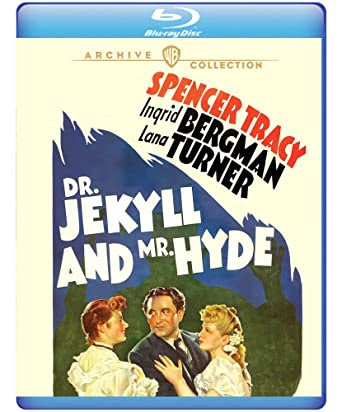
On Blu-ray: Spencer Tracy, Ingrid Bergman, and Lana Turner in Dr. Jekyll and Mr. Hyde (1941)


While the 1931 version of Dr. Jekyll and Mr. Hyde starring Fredric March remains my favorite, MGM’s 1941 production starring Spencer Tracy has grown on me over the years. I still find it overlong and too heavy on the dialogue, but there’s much to love about it. I recently revisited the film on a new Blu-ray from Warner Archive. 

One of the most fascinating elements of this take on Robert Louis Stevenson’s Victorian tale of a scientist who brings out his evil side is that a studio known for going big with everything in its lavish productions did very little with make-up when it came to Tracy’s transformation to Hyde. His brow is darkened and his features made to look more severe, but Tracy’s acting is what makes the alter ego he plays so chilling. He perfectly embodies the dichotomy of a man, from the mask he wears as he moves in society to the more animalistic desires raging beneath that façade. 

Much has been made of the casting of the female leads in this film. For some the casting of the fresh-faced Ingrid Bergman as tortured bar girl Ivy and bleach-blonde Lana Turner as Tracy’s virginal intended seems backwards. I thought that at one time myself, but I’ve come to realize that the film wouldn’t have worked had the roles been switched. 

For the most part this is because the role of Ivy requires an intensity that Turner would never have on the screen. Bergman gives a deeply harrowing performance, going to frantic emotional heights that few actresses of the period would be able to match. It is an exponentially more challenging role. 

On the other hand, Turner was well suited to playing the young and innocent Beatrix. This was years before The Postman Rings Twice (1946) and audiences at the time would have felt the part suited her persona. It was also the perfect role to showcase what she did have to offer as an actress. 

It’s a solid trio of performances, but they aren’t in the film they deserve. There’s more talk than action, especially in the early scenes and those scenes go into far more detail than is necessary. It is here where I vastly prefer the pre-Code version. 

There is a bit of that pre-Code spirit in the film’s surreal and erotic dream sequences though. Tracy’s sexual frustration is illustrated in a series of sensual and downright kinky fantasies centered on the two women in his life. How did the image of Tracy whipping Turner and Bergman as his bare-shouldered steeds made it past censors? Perhaps the scenes were viewed as art; whatever happened, it’s these moments that give the film a wild edge that is much needed to cut through the MGM-style pomp. 

This is for the most part a satisfying film; Tracy’s performance alone makes it a classic. 

As a special feature there is also a theatrical trailer on the disc. 


Many thanks to Warner Archive for providing a copy of the film for review.

May 18, 2022

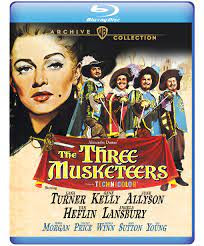
On Blu-ray: Gene Kelly and Lana Turner in The Three Musketeers (1948)


The Three Musketeers (1948) may not be one the most celebrated of MGM’s films, but it has all the best that the studio had to offer. It’s full of action, with just the right amount of humor, its stars are for the most part perfectly cast, the costumes are gorgeous, and the Technicolor lends it all an unreal beauty. I recently enjoyed all these things on a new Blu-ray release from Warner Archive which looks great and gives the film a refreshed look. 

It makes sense that Gene Kelly would thrive in an action film. His bruised dance partners (and Lana Turner in this film) had stories to tell about his occasional overabundance of energy. Here he had a good outlet for that boundless physicality. He is a good fit for D’Artagnan, because while there are emotional elements, the part calls mostly for derring-do. 

Van Heflin takes on the dramatic duties as Arthos and he works well with the lighter Kelly. Lana Turner is also striking as M’Lady; her role is written more to showcase her screen presence than dramatic ability, though she has her moments and lends a delightfully twisted edge to her villainous character. The camera focuses on her like a crushed out teenager and she is breathtakingly stunning in her color film debut. Vincent Price is also reliably evil, seeming to pioneer the now long-standing villain tradition of stroking a cat while plotting wicked deeds. 

I always feel guilty about my dislike of June Allyson. While I can see objectively that she is talented, there’s something about her that leaves me flat. I could understand the freshness of her persona as Constance being appealing here for those who are fans, but I found her to be a mismatch with Gene Kelly. 

The cast is filled out with Angela Lansbury, Frank Morgan, John Sutton, Gig Young, and Keenan Wynn all of them understanding the assignment. There’s a lot of talent to behold here. 

Overall this is engaging, well-paced moviemaking. Costume dramas aren’t a go-to genre for me, but so many things go right with this production that it has an appeal which elevates it beyond category. It’s the kind of film you imagine when you think of the studio classics. Aside from the great production values and performances, the story is more engrossing because it is one of the first Musketeers adaptations to adhere more closely to the source material. It’s a good time. 


Many thanks to Warner Archive for providing a copy of the film for review

Jul 14, 2021

On Blu-ray: Costume Dramas Green Dolphin Street (1947) and The Private Lives of Elizabeth and Essex (1939)


This pair of dramas newly on Blu-ray from Warner Archive features two vastly different, but equally wrenching explorations of the complications of love. In both cases the turmoil is set in grand locations with actors in lavish costumes. 

Green Dolphin Street (1947) 

Based on the novel by Anya Seton, this drama/disaster film stars Lana Turner and Donna Reed as sisters Marianne and Marguerite, who live with their parents in the Channel Islands in the 19th Century. They both fall for their neighbor William (Richard Hart) who happens to be the son of Dr. Edmond Ozanne (Frank Morgan) who their mother (Gladys Cooper) reluctantly gave up in her youth for a more wealthy and socially-connected husband (Edmund Gwenn). The poor but intriguing Timothy (Van Heflin) watches from the sidelines, in love with Marianne, but aware he can never have her. 

William falls for Marguerite and when he settles in New Zealand, where he connects with the now successful Timothy after a disastrous mishap in the Navy, he attempts to send for her, but in a drunken stupor writes Marianne’s name in his letter instead. This unlikely mistake forms the basis for considerable heartbreak. It’s the flimsiest anchor for the story and requires a certain level of belief for the film to work at all. 

That error is a weak link in an overlong production that never quite gels. The colonial perspective on the Maori people doesn’t help as seen through modern eyes. 

There’s a certain moody romanticism to it though, helped along by the sweeping theme song which would evolve to become the jazz standard On Green Dolphin Street. James Wong Howe’s cinematography is also magnificent; he especially knows how to light Turner to her best advantage. Add to that a nail-biting earthquake sequence and there’s enough to recommend this exploration of desire, loss, and finding satisfaction in unexpected ways. 

Special features on the disc include a radio production of Green Dolphin Street and a theatrical trailer.

The Private Lives of Elizabeth and Essex (1939) 

There’s a reliable cinematic grandeur to the costume flicks Warner Bros. produced in the classic age. The studio had the formula down: a brightly trumpeting score, glam costumes, settings that are just lavish enough, and a reliable cast of supporting characters. The Private Lives of Elizabeth and Essex has all of that, and the sparkling print on the new Blu-ray elevates it further, but a weak connection between the leads keeps it from greatness. 

In order to succeed, this adaptation of the play Elizabeth the Queen needed chemistry between its queen and earl. While there are moments that Bette Davis (as Queen Elizabeth) and Errol Flynn (as the Earl of Essex) connect, their personal dislike of each other is too evident for them to truly sizzle. Instead of giving the union tension, the conflict makes them appear cold and distant. Davis had not enjoyed her experience starring with Flynn in The Sisters (1938) and she wanted Laurence Olivier to play his role, so it is clear that the contempt was much stronger on one side. 

Independently, Flynn gives a moody, thoughtful performance which feels unusually sincere. Davis is less effective. She can’t help but be grand and imminently appropriate in the role of a queen, but she relies too much on distracting physical ticks: a weaving head, twitching hands, to build her character. The supporting cast is solid in that cheerfully efficient Warner way, with Olivia de Havilland, Donald Crisp, Alan Hale, Henry Daniell, and Henry Stephenson comfortably revisiting the period film milieu. Vincent Price and Nanette Fabray are also pleasing in roles that came early in their careers. 

Special features on the disc include a carry-over from previous DVD editions of the Leonard Maltin’s Warner Night at the Movies 1939, which includes a newsreel, the musical short The Royal Rodeo, the cartoon Old Glory and a theatrical trailer. There’s also the featurette, Elizabeth and Essex: Battle Royale. 

Many thanks to Warner Archive for providing copies of the films for review.

Jan 8, 2020

On Blu-Ray: The Luscious, Vicious Hollywood of The Bad and the Beautiful (1952)


In telling the story of a charismatic cad, The Bad and the Beautiful (1952) encapsulates all the glory, glamour, despair, and depravity of Hollywood. Director Vincente Minnelli’s portrait of the manipulative filmmaker Jonathan Shields (Kirk Douglas) feels so real that you can’t help wondering who was the inspiration for this man and the cast of characters that surrounds him. Now available on Blu-ray from Warner Archive, the film looks great and has retained its devastating power.

The story plays mostly in flashback, with a framing device in which producer Harry Pebbel (Walter Pidgeon) tries to convince actress Georgia Lorrison (Lana Turner), screenwriter James Lee Bartlow (Dick Powell), and director Fred Amiel (Barry Sullivan) to speak with Shields about a new production. The filmmaker is down-and-out, but this trio has taken plenty of professional and personal grief from Shields and they are understandably wary of him. Pebbel tries the risky tactic of asking them to reminisce about their times together, in the hopes they will find something good that makes them want to work with him again.

This vibrantly-told tale was based on George Bradshaw’s 1949 story Of Good and Evil, which was later released in an expanded version as Memorial to a Bad Man. It was originally set in the New York theater world, but producer John Houseman found it more interesting and novel to focus on Hollywood. He certainly had plenty of material to work with; it is rumored that Shields was crafted out of the personalities of Val Lewton, Orson Welles, and David O. Selznick.

The film made a profit, and won many accolades, including five Academy Awards out of six nominations. Douglas was nominated, and Gloria Grahame won supporting actress for barely over nine minutes of screen time, a record for shortest nominated appearance at the time.

While any acting nomination for The Bad and the Beautiful would be well deserved, it is always Lana Turner who gets to me the most. She so effectively communicates the hurt and yearning beneath her perfect blonde beauty. You could see just about anyone in this film bouncing back from disappointment, even Shields, but Turner’s take on Lorrison gives you the impression that she will always be a bit haunted and that feeling, coupled with the genetic burden of alcoholism, seems constantly ready to claim her.

Perhaps the most fascinating aspect of the film is that while it is so much about the dark side of Hollywood, it is also a perfectly pleasing Tinsel Town product: lushly glamorous, passionate, and vibrant with the charisma of its astonishing cast.

Special features on the Blu-ray include the TCM-produced documentary Lana Turner…A Daughter’s Memoir (2001), scoring session music cues, and theatrical trailers.


Many thanks to Warner Archive for providing a copy of the film for review. To order, visit The Warner Archive Collection.
Sep 6, 2017

Blu-ray Review: Lana Turner and John Wayne, An Oddly Compelling Pair in The Sea Chase (1955)


John Wayne, German. It doesn't make sense on paper, nor does it on the screen. In The Sea Chase the All-American cowboy doesn't seem remotely European, but he is reliably heroic as a morally sturdy naval officer in this sturdy war drama. He even makes you buy that Lana Turner, as a glamorous spy, could fall for him.

Wayne is Karl Ehrlich (really), a naval captain stationed on a freighter called The Ergenstrasse in Australia at the start of World War II. Though he despises Hitler, he realizes he must consider his crew's right to choose where their allegiances rest. He sets sail, escaping internment by the British, and takes on the challenge of returning his men to their homeland.

Facing the threat of mutiny, a treacherous Nazi sympathizer on his crew, and being under hot pursuit by the Brits, Ehrlich's life is further complicated by the arrival of Elsa Keller (Turner), who is also on the run. As the only woman onboard she is another dangerous distraction as he scrambles to find more wood to fuel the drastically understocked ship.

Of course Wayne and Turner have to fall in love, even if you'd never put them together. As a couple, they don't sizzle; this isn't a hot movie romance, but it is intriguing. It's more that they express the exhaustion of people who have lived hard and are ready for the comfort of someone who understands them. 

The love affair wouldn't have worked if Turner had landed in one of Wayne's westerns or he in one of her high-toned dramas, but the open seas is a fine middle ground. Their regard for each other is what makes them so touching together.

Turner slinks around in a tight, low-cut white dress, making the crew members drunk with lust. Wayne is scandalized; he knows she has driven a man to suicide. For her it is simply life, she causes a fuss as a matter of course; it has become background noise to her. 

So has dressing to kill. There's no need for her to wear a jaunty red scarf with her tight white sweater while stuck on a freighter, but it's how she plays the game and perhaps the glamour cheers her up. Also, she is Lana Turner, movie star. Even when she has to resort to men's dungarees to have clean clothes, she works it.

The pair are supported by a solid cast, with reliable actors like Dick Davalos (East of Eden), Alan Hale and James Arness onboard. Tab Hunter also makes an early appearance as a crewman. At this point in his career he couldn't even shout "land ho!" convincingly, but he clearly has presence.

Though this isn't quite the pulse-pounding actioner it aims to be, the slow build tension can be effective. Director John Farrow provides some genre thrills while also capturing the despair and destruction of this mostly self-contained bit of World War II drama.

Many thanks to Warner Archive for providing a copy of the film for review. To order, visit The Warner Archive Collection.

Jul 6, 2010

TV Tuesday: Lana Turner on Donahue (1982)


I've got another great Lana Turner clip to share this week. I love the way she is holding court on this 1982 episode of The Phil Donahue Show. It's a marvelous performance! I especially like the way she uses that fan as a dramatic prop.

Jun 29, 2010

TV Tuesday: Lana Turner and Jane Wyman on Falcon Crest


Lana Turner and Jane Wyman have it out in this juicy scene from a 1982 episode of Falcon Crest. I miss nighttime soaps like this one. It makes sense to me that so many classic Hollywood stars appeared in them, because these shows were the closest you could get to a 1940s-50s style production in the 1980s. I mean, people dressed for dinner, they acted larger than life and there was lots of melodrama; that's pure old school Hollywood.

I think the only way a show like this could survive today would be as a parody. And I'd take that just to see this kind of crazy glamour on television again!

You can watch the full episode (and nineteen more) here at WB online.

May 15, 2010

Saturday Newsreel: The 1966 Academy Awards

This is actually a backstage interview with Lana Turner, Kathryn Grayson and James Garner. Aren't they glamorous? I love the ladies' big '60s hairdos and fancy jewelry. At the end, there's brief silent portion with other winners from the night, including Julie Christie in that amazing gold dress she wore to accept her statue for Darling (1965). Also making an appearance: Shelley Winters, Lee Marvin, Martin Balsam--and I think George Sanders? Am I missing anyone?