Showing posts with label Ginger Rogers. Show all posts

Mar 9, 2022

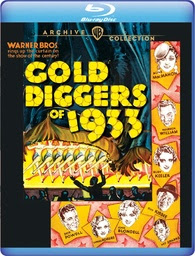
On Blu-ray: Golddiggers of 1933 (1933)


Golddiggers of 1933 is a triumph of cheerfulness and cynicism. Take that opening number, unfolding in the middle of the Depression. A chorus of glamorous showgirls garbed in golden coins, led by the upbeat and impeccable Ginger Rogers, sings about wealth and prosperity moments before their costumes are repossessed for non-payment. They will go home to steal milk from their neighbors, crammed together three to a room. It’s a number that dares to dazzle before quickly cutting to a shot of a producer played by Ned Sparks, chomping a cigar, unimpressed and sour-faced. It lathers on the cheer, but all the while it pokes at the worries of the time, a magnificent feat of escapism and realism combined. 

I was giddy to watch the film again on a new Warner Archive Blu-ray. It certainly looked a lot better than the version I taped off public television as a kid and played to shreds. There’s something special about the films you’ve watched so much that you know every line, glance, and musical cue. 

Golddiggers of 1933 possessed the best Warner Bros. had to offer: direction by Mervyn LeRoy, dance direction by Busby Berkeley, and a cast of the studio’s best players, including stars like Dick Powell, Joan Blondell, and Warren William and beloved character actors Guy Kibbee and Ned Sparks. 

The film’s airy approach to the most dismal topics is remarkable. Starving chorus girls Aline MacMahon, Ruby Keeler, and Blondell lament their hunger and the poverty that has forced them to pawn their clothes and valuables. They also warn each other about handsy show producers, but always with a sarcastic smile and snappy delivery. Men with power like William and Kibbee try to control their world, but the steel beneath these cheery women always comes through, and they find themselves footing the bills for expensive hats and nightclub dinners. 

Every other line tells you this is a pre-code movie and that racy vibe extends to the jaw-dropping Pettin’ in the Park number, which is horny even for the era. Pre-teen Billy Barty is dressed as a baby, rolling around on skates ogling scantily-clad show girls, they pretend to disrobe and shower behind a diaphanous curtain, and the final joke is a baby offering a can opener to a frustrated boyfriend who can’t handle his lady’s metal garb. Describing it all makes it even more astounding that it ever made it to the screen. 

In the end Golddiggers of 1933 triumphs because while it faces reality, it also asks you to believe in millionaire songwriters with open checkbooks, stage productions that hire all your friends, and Broadway shows with a multitude of close-ups that no one in an audience could ever see. It closes with a devastating number about the plight of World War I's Forgotten Man and it somehow leaves you exhilarated. It looks at reality and gives you pure fantasy. 

Among the many special features on the disc from previous DVD releases, there’s an especially interesting newsreel about the 42nd Street Special, a train which crossed the USA packed with film stars promoting Warner Bros. Bette Davis was on that train (and is in the reel); in an interview years later, she recalled that the train was not always well received, because wealthy film stars were the last thing a lot of struggling Americans wanted to see at the time.

Many thanks to Warner Archive for providing a copy of the film for review.

Mar 13, 2019

Pre-codes on DVD: Ginger Rogers in Professional Sweetheart (1930) and Helen Twelvetrees in Unashamed (1932)


There's nothing more welcome on my doorstep (apologies to my cats) than a package of pre-code films. Here's a pair of new releases from Warner Archive that I recently viewed:

Professional Sweetheart (1930)

This lively romantic comedy catches Ginger Rogers before musical fame, but already in the full bloom of her charms. She’s plays a radio star with a spotless image, called the “purity girl,” but desperate to cut a rug in Harlem and dropkick her reputation for a little fun.

In order to convince her to sign a new contract, the radio station suits allow her to pick a boyfriend from the bulging files full of the love letters and photographs she receives from her fans. The handsome, but dull Norman Foster is the winning pick. Rogers is pleased, and despite initial misgivings doesn’t even mind him whisking her off to the country to take care of his modest home, but the call of stardom is powerful as long as there is a radio in the corner of the living room.

She hears her maid (Theresa Harris) filling her position on-air and doing a little too well in the role at that. Seeing the always charming Harris shed her maid's uniform for an evening gown and a place in front of the microphone was one of the highlights of the film for me. Unfortunately, her scenes as a star were brief and it is never explained what happens to her when Rogers returns to claim her crown.

Though Rogers’ scrappy, but sparkling singing voice was one of the most charming aspects of her persona, here I was alarmed to find she was dubbed by the talented, but more operatic Etta Moten. It took some getting used to, though it wasn’t unpleasant.

Rogers is surrounded by some of the best of the Warner Bros contract players; they’re the people that make you grin when they pop up in a scene. There’s Zasu Pitts as a half prim/half randy lady rag journalist, Frank McHugh, Allen Jenkins, and Gregory Ratoff prancing through their shtick as radio executives, and then dear, bland Foster justifying his presence with a strong jaw.

It’s the kind of Warner’s pre-code production where the racy stuff is inserted in lightning-fast moments and everyone knows exactly how to keep the action moving. Not a classic, but a very good time.


Unashamed (1932)

Fans of Helen Twelvetrees will find little to surprise them in Unashamed. This murder-courtroom melodrama has the gowns, plucked eyebrows, and romance-gone-wrong that were firmly in the actress’s wheelhouse. Costarring Robert Young in his adorable young man phase, Lewis Stone, and Jean Hersholt, it is a production meant to reassure more than tread new ground.

Twelvetrees is wealthy young Joan, devoted sister to her brother Dick (Young), affectionate daughter to her father (Robert Warwick), and poor romantic decision-maker all on her own. She falls under the spell of cash poor polo player Harry (Monroe Owsley) and doesn’t see him placing her into a trap via sexual scandal until it is too late.

Dick defends his sister's honor in a heated confrontation that ends in him killing the sleazy homme fatale. Still blind to her lover’s faults, Joan refuses to stand up for her brother in court. Of course she eventually bows to family bonds, whatever the sacrifice, in the end.

This unremarkable, but smoothly assembled production is best recommended for fans of Twelvetrees and Young.

Many thanks to Warner Archive for providing copies of the films for review. These are Manufacture on Demand (MOD) DVDs. To order, visit The Warner Archive Collection.

Apr 17, 2017

TCM Classic Film Festival 2017--The Films Part One: Nitrate and the Newly Restored Egyptian Theatre


Of the many things I looked forward to experiencing at TCM Classic Film Festival 2017, checking out the Grauman's Egyptian Theatre remodel and the four nitrate films to be shown there were at the top of my list.

I have wanted to see film on nitrate for years. Stories of how the format shimmers, and brings out the depth of images fascinated me, not to mention that the stock actually has silver in it. This is literally how the term "the silver screen" came to be.


The forecourt of the Egyptian
While I have always enjoyed seeing films at the Grauman's Egyptian Theatre, at last year's festival I noticed how threadbare the carpet had become and that parts of the building were beginning to crumble away. It was clear that the facilities needed some TLC. This year I was delighted to find the theatre looking as good as new.

The Theatre Remodel and Restoration


The Egyptian Theatre was last remodeled in 1998, when the not-for-profit cultural organization American Cinematheque took on ownership of the building and launched a massive renovation project. This restoration returned the theatre to its former glory and updated its technology.


However, after nearly two decades of heavy use, the theatre was once again in need of attention. Water leakage caused extensive damage to the ceilings inside and in the portico just off the forecourt of the building. The elaborate Egyptian-themed paintings in the forecourt were faded and cracked by the elements. In addition to worn carpet, the auditorium seats were beginning to show their age.

While not as elaborate as the last restoration, it nevertheless took a major effort to once again restore the theatre. With funding primarily from The Hollywood Foreign Press Association, all these issues were addressed, from restoring the murals and inside paint, to fixing the water damage and ensuring that the building was better protected from rain and other elements.


A gorgeous design and that new carpet smell!

Every seat in the auditorium was recovered and new, custom-designed carpets were installed. One of the most fascinating elements of these new floor coverings is that their design mirrors that of the ceiling details in the auditorium. A semi-circle starburst on the floor of the theatre entry matches exactly with the design inside the theatre.

The ceiling art that was mirrored in the lobby carpet design
In addition to restoring the facility, the projection room was completely rebuilt to accommodate new technology and to enable the safe projection of nitrate film. Fire curtains, high-tech extinguishing equipment and other features will help to ensure that if any nitrate film ignites during a screening, the theatre and its patrons will remain unharmed.


Restored forecourt art

Nitrate Film

In her opening night introduction, Deborah Stoiber, collection manager of the moving image department of George Eastman Museum told the audience that the ability to show nitrate at the theatre, from facilities to films was funded by The Hollywood Foreign Press Association, Turner Classic Movies and The Film Foundation in partnership with the American Cinematheque and the Academy Film Archive. That's an impressive group, offering an amazing experience for classic film fans. It is easy to see why TCM staff were so eager for festival goers to attend the four nitrate films on the schedule.

I liked the films that were selected, because they offered a diverse look at nitrate film. Two black and white and two color films were shown and each was stunning in its own way. There was Alfred Hitchcock's original 1934 take on The Man Who Knew Too Much, the quintessential noir Laura (1944), Powell and Pressburger's visually stunning Black Narcissus (1947) and the odd, but beautiful Lady in the Dark (1944).

I found the format to be a revelation, with sometimes subtle, but often noticeable differences in the way light and shadow appeared on the screen, and images more lush and with deeper dimension. These were among my favorite screenings of the festival, living up to my expectations for an excitingly different cinematic experience.

One of the most interesting things I noticed about viewing nitrate with an audience, was that it was not a unanimously thrilling experience. Some festival goers were rendered speechless by the beauty of the images, while others were completely underwhelmed. I spoke to quite a few attendees who could not see what was so magical about this format. While my seatmates raved about the look of Laura, another audience member was disappointed in the experience and felt it was a bad print. I hadn't expected that division of opinion and still haven't got a theory as to why so many of us experienced nitrate in such dramatically different ways, though you could really say the same thing about tastes in film overall.


The Man Who Knew Too Much (1934)


A nitrate film was shown each night of the festival at the Egyptian. Stoiber spoke about the opening night selection, sharing some information about the film print itself. Struck in 1946 for David O. Selznick, it had been donated to the George Eastman Museum by his son Danny. The producer had been interested in viewing the British works of his contracted director Hitchcock. Stoiber also noted that this was Peter Lorre's first film in English.

Then Martin Scorcese took to the podium to offer a more wide-ranging assessment of nitrate, which I found to be an essential introduction. He noted the drawbacks of the format: that it was highly flammable, did not even extinguish in water and would decompose into powder. He said that by the late forties the format had been replaced by acetate, also known as safety stock. No further feature films were made with nitrate after around 1952. The director told a groaning audience that many nitrate prints had been destroyed so that the silver in them could be removed.

Then Scorsese raved about the look of nitrate: how its high silver content resulted in deeper blacks, and a greater spectrum of greys and how with Technicolor the colors were pressed into the film, as if the images were embossed, making the films highly resistant to fading. He called the format, "a different kind of beauty," with lustrous images and a luminosity to it.

I don't know how I would have experienced The Man Who Knew Too Much without this introduction giving me a sort of heads up as to what to observe. I suspect I probably would have thought it was exceptionally filmed or a high quality print. As it was, I saw exactly what Scorsese was talking about, not at first, but as the film progressed.

In this tightly-paced, tense Hitchcock thriller, there are lots of dramatic contrasts in color. I first understood the power of those contrasts in a nightclub scene in which the deep blacks of the men's tuxedos were a stunning contrast to the shimmering glow of the ladies' gowns. I also enjoyed the almost liquid look of the light when it reflected on shiny objects, and in particular the way it snaked down the barrel of a gun in a climactic scene. On the light side of the spectrum, I was spellbound by several profile shots of leading lady Edna Best, where the light on her skin and curled coiffure seemed almost to take on a life of its own.

The most stunning visual effects were in the tense final scene, which took place at night. My first glimpse of the deep blacks on a dark street made me gasp. They were so intense and showed so much detail. Overall I felt more engaged in this film which I had always liked, but not found terribly interesting, because the visual experience was more dramatic.


Laura (1944)

The screening of this Otto Preminger film noir was my favorite of the black and white nitrate presentations. In contrast to the more stark feel of The Man Who Knew Too Much, the look of Laura was luxurious and sensual. I understood what Scorsese meant when he said it was, "one of the most haunting uses of black and white." While the rest of the nitrate films shown tended to have certain moments where the effect of the format was more pronounced, viewing this film was a uniformly mesmerizing experience.

As many in the audience had seen the film several times before, there was a bit of collective disappointment that there were so many breaks in the film. Those who had all but memorized the script were somewhat taken out of the moment by lines that cut out in the middle and other minor breaks. I wasn't too bothered by this, but that was most likely because I had attended the screening with the intention of making the most of the nitrate experience.


Black Narcissus (1947)

In his opening night comments, Scorsese said that he believed this 70-year-old print was one he had seen at the Academy theater in the 1970s. He said he had been late to the screening and sat in the third row, which to him made the film appear like 3D. After wandering the theater with a pair of seatmates as indecisive as I am, we ended up in the second row and got to see the film as he had.

Normally I hate sitting that close, but I suspected it would be an amazing way to see this film, and I was right. This intense story of a group of nuns who attempt to establish a nunnery in the Himalayas, only to be driven mad by the strange environment and mystical feel of the place is best experienced in total immersion.

It was at this screening that I found the most rapt response from the audience. There were moments when I could tell that others were experiencing the same wonder I was. The most stunning moment was in a flashback scene with Deborah Kerr, in which she is standing with a fishing pole in a river. I remember thinking this was a pretty scene before, but the sparkle of the water in nitrate was unreal. You could feel a crowd of hundreds collectively holding its breath. I still think about that moment with wonder, because I never knew film could have such an utterly overwhelming effect.

I also found it interesting which scenes were most entrancing to me in nitrate. While the mountain backdrops were as beautiful as I expected, I found that the interiors most often grabbed my attention, from the play of light on a nun's habit, to the flicker of a young student's eyes. There's one scene in particular that amazed me, where a simple bar cart appeared as perfectly bathed in light as a Vermeer, with the bottles and glasses shimmering and seeming almost to be 3D.


Lady in the Dark (1944)

My final nitrate film was also the last of the festival for me. Scorsese had praised its, "real, vibrant Technicolor," but I had heard the story of this rarely seen film was not to modern tastes.

This was the one nitrate film that most of the audience hadn't seen, and there was an interesting buzz about it afterwards. It stars Ginger Rogers as a emotionally-conflicted magazine editor who is chided by her co-worker Ray Milland for her seriousness and supposedly plain and manly clothes. She struggles to understand her anxiety, and her reluctance to commit to both her longtime lover (Warner Baxter) and a much sought-after movie star (Jon Hall) who takes an interest in her. She begins to see a psychiatrist (Barry Sullivan), who brings all his 1940s male chauvinism to her diagnosis, but does uncover the reasons for her distress.

This is a profoundly sexist film. While I was a little surprised by the pearl clutching by audience members afterwards, after all, as classic film fans we see plenty of plots like this one, I did have to admit that this take on the duties and roles of females was particularly distasteful. Even Rogers' therapist thinks that she'll be fine as long as she eases up on the work responsibilities and starts dressing prettier.

I still adored this film though, because like most films directed by Mitchell Leisen, it is gorgeous. With outrageous costumes by Edith Head, including a show-stopping mink and sequin number that cost thousands, luxurious set dressings and surreal dream sequences that could stand on their own as entertaining shorts, this was definitely a film to soak in on a superficial level. If you can set aside your analysis of 1940s society, it can be an intensely enjoyable experience.

Once again it was clear why Lady in the Dark had been chosen for the nitrate screenings. The colors really popped, skin looked velvety and touchable and even something as simple as a leather chair had a shimmering wow factor.

I am delighted that my nitrate experience at TCMFF turned out to be as impressive as I'd hoped. Though I don’t know if I prefer it to other formats, I do think it is a wonderful way to view films. I'd love to see more movies on nitrate and hope that TCM will screen the format again in future festivals.

This is a great video with more details about the Egyptian Theatre restoration:


Check out my full TCMFF 2017 coverage here.

All photos property of A Classic Movie Blog

May 9, 2015

Screenshots of the Week: An Arrow Through the Heart


Ginger Rogers in Carefree (1938)


Madonna, 2015

Here are some lovely additions courtesy of Dsata:


Richard Egan and Jane Russell in The Revolt of Mamie Stover (1956)


Model photographed by Nina Leen, 1947


Hans Makart, Detail from The Dream after the Ball, 19th Century

May 6, 2015

42nd Street (1933) Sparkles on Blu-ray


The Warner Archive Blu-ray edition of 42nd Street glimmers from the first frame. Even the title card looks magnificent. The credit "Silks by the Cheney Brothers" never looked more glamorous. To see the film that I watched dozens of times as a teenager on a VHS copy recorded from TV this way is almost like seeing an entirely new production.

42nd Street revived the screen musical after a brief period where audiences, tired of the glut of early sound productions, were unwilling to endure another awkward kickline or ungainly dance specialty. It had polished dialogue, full of snap and cynicism, sleek, sharp-witted showgirls and it wasn't afraid to show the unglamorous exhaustion and heartbreak at the center of it all.

It's easy to forget that Warner Baxter, Bebe Daniels and George Brent were the headliners of this influential musical. While they are sympathetic and effective in their roles, they always seem to be playing support to the supporting players. 

Full of youthful confidence and energy, Dick Powell and Ruby Keeler steal the movie--they're the first thing you think of when you hear the title. Not far behind them are the now familiar cast of Warner Bros players: the sleazy boob Guy Kibbee, flat-voiced Ned Sparks, the simultaneously delightful and irritating Una Merkel. And then there's Ginger Rogers, already something special and ready to grab the spotlight.

As much as Ruby Keeler grates on me, with her slow-witted line readings and the anxious way she glances at her clomping feet, she is the only star who could have played the ingénue who becomes a star overnight. Everyone else knows where the bodies are buried, only Keeler can portray a woman who doesn't know enough to realize the full risk of her situation, but is wise enough to raise an eyebrow when a man closes a door behind her. She's equal parts clod and sparkling and perhaps that's the magical combination: she's both girl-next-door and fast-tapping superstar.

Keeler is the only female cast member to get to the top with her taps. Daniels, Merkel, Rogers and the mysterious chorine with a Park Avenue address ("is her homework rough!") all lean on men to get ahead. It's a dark message, barely glossed over by the sprinkling of musical numbers at the end. Even there, the dominance of men is reinforced, with a dancer being stabbed to death in a vignette.

Dance director Busby Berkeley's staging of the thrilling 42nd Street finale is a chills-inducing production, because you know how much passion went into it. All the sore feet, shouting and exhaustion have come to this giddy moment and you can see the joy in the performers. Their feeling of accomplishment and delight in performing is palpable. The number brought the fun of musicals back to the silver screen, by showing how much heart they had. After that, a revival of the genre was inevitable.

Special features on the disc include a fascinating featurette on the history of the 42nd Street book and musical, brought over from the DVD release. There are also a couple of cartoons, a newsreel and a short film paying tribute to composer Harry Warren, whose significant contribution to the film and musicals in general is often overshadowed by the flash of Busby Berkeley's dance direction.

Many thanks to Warner Archive for providing a copy of the Blu-ray for review. To order, visit The Warner Archive Collection.

Mar 5, 2014

My Movie Book Library: Did Ginger Rogers Really Sign My Copy of Her Autobiography?


Since Ginger: My Story is on my list of books to read from my library this year, I thought I'd pull it out and add it to my stack-in-progress. I started to flip through it and was a bit startled to find this on the title page:


Is that really Rogers' signature? I kind of remembered seeing it before and assuming it wasn't real. Don't know why I didn't think of it before, but I thought I'd try to find the real deal online and make a comparison. I checked out a few dealer sites and almost all of the supposed Rogers signatures looked like this:


Similar, but not too similar. I can see how I could have the real thing. Should I bother to find out?

Do you have any books or memorabilia signed by classic stars? Have you ever had an appraisal done to determine if a signature is real? 

May 5, 2011

Ginger Rogers on "Here’s Lucy"


In this 1971 clip from Here's Lucy, 60-year-old Ginger Rogers shows she still has it as she dances a lively Charleston with Lucille Ball and Lucie Arnez. The also 60-year-old Ball does pretty well herself. That crack she makes about Rogers winning the Texas state Charleston competition is actually true; she won the contest as a teenager.

Aug 15, 2010

Quote of the Week


If you don't stand for something, you will stand for anything.

-Ginger Rogers

Image Source

Dec 28, 2009

Monday Serenade: Ginger Rogers

Here's Ginger Rogers in one of her first starring roles, singing How I Wish I Could Sing a Love Song with Jack Oakie in The Sap From Syracuse (1930). If it weren't for Rogers' distinctive vocal style, you almost wouldn't recognize her. The more familiar wisecracking platinum blonde would emerge just a few years later.

Jul 8, 2009

Rogers and Astaire: An Animated Homage


Watch Fred Astaire and Ginger Rogers pop out of a pair of cigarette packages and dance together in this clip from the Warner Bros. cartoon, September in the Rain (1937). Now look at the clip below to see the original dance, which takes place in the last few minutes of The Gay Divorcee (1934), to see how similar the routines were, down to tiny details (look out for a step Rogers makes on the way up, but not on the way down). Skip to the 2:00 mark for the dancing: