Mar 23, 2022

Watching Classic Movies Podcast: Talking Classic Film Biopics with Kristen Lopez of Ticklish Business

My guest this week is Kristen Lopez of Ticklish Business. She's one of my favorite classic film bloggers and podcasters. Kristen has long had an interest in classic film biopics. We talked about the hits and misses in this most fascinating genre. 


Keep up with Kristen: 

The show is available on Spotify, PocketCasts, Breaker, Stitcher, Anchor, Google and Radio Public.

Watching Classic Movies podcast is also available on Apple Podcasts! If you are enjoying the show, please give it a 5-star review.

Like the podcast? Want to hear more frequent episodes? Click on the Support button here


Mar 21, 2022

TCM Ultimate Movie Trivia Challenge: Yes, it Stumped Me a Few Times


I’ve long thought it would be great to have a classic movie trivia game for waiting in line at TCM Classic Film Festival. Now TCM itself has come through itself with a card deck that delivers as far as being accessible for fairly new fans of the classics, but offering some challenge for long-term cinema obsessives like me. 

The TCM Ultimate Movie Trivia Challenge is a 100-card deck with four questions on each card. The back of each card is labeled with one of eight categories: The Great Films, Leading Ladies, Leading Men, Directors, Cult Classics, Supporting Players, Behind the Scenes, and Unforgettable Lines. I liked having the flexibility to choose a category; the Cult cards were especially fun because of their wild variety. 

Any regular viewer of TCM should enjoy these cards. As someone with a deep knowledge of classic movies, I knew many of the answers easily, but there were plenty that stumped me, and those I did know often had a few interesting tidbits in the answer that were new to me. 

In a time where I often fail to disconnect myself from the social media doom scroll and all the attendant horrors, it was nice to unplug with this. It reminded me of how healing it can be to embrace the simplicity of playing games, especially when they focus on a subject I deeply love. 


Many thanks to TCM for providing the trivia game for review.

Mar 18, 2022

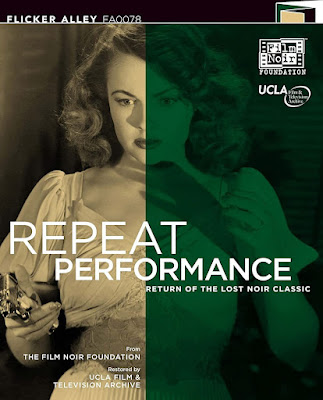
Noir on Blu-ray: Repeat Performance (1947) with Joan Leslie, A Gem Restored and Saved from Obscurity


Joan Leslie spent most of her career playing sweet-faced ingénues, which isn’t unfortunate in itself, but she did have more to offer as an actress. She proves this in Repeat Performance (1947), a unique fantasy/noir/melodrama in which the actress plays her most complex and mature character. 

Now available on a DVD/Blu-ray release from Flicker Alley, this production was almost lost to time, barely saved from a tattered print. Thanks to the fundraising of the Film Noir Foundation and restoration efforts by UCLA Film and Television Archive, Repeat Performance is not only available, but it looks amazing. 

Leslie stars as Sheila Page, a successful stage actress in a toxic marriage. She commits a murder in the opening scene and, blaming it on her bad choices over the past year she wishes she could live 1947 again and fix everything. Basically she wants to rewrite this act of her life, just like the plays in which she stars. She gets her wish, but quickly learns how little control she has over her alcoholic, resentful husband (Louis Hayward) and those around them. 

One of the best elements of the film is the supportive men in Sheila’s life. As her producer John Friday, Tom Conway is sympathetic, supportive, and believes in her no matter what wild stories she tells him about bending time. In his film debut as Sheila’s queer-coded poet friend William, Richard Basehart is also moving as a thoughtful and wise confidant whose gentle demeanor is at odds with the chaos around him (he’s also got the most luscious head of hair). It makes her co-dependent marriage with Hayward seem all the more absurd as she is putting so much into an unhealthy relationship when she is surrounded by far better examples of masculinity. 

The fantasy portion of the film is almost an afterthought. It plays with time as a means to launch the noir/melodrama. Once Sheila leaps into the past, little is said of it; there isn’t even much astonishment. 

Instead, the focus is on a cast of characters which proves to Sheila’s increasing frustration that trying to control people like characters in a play is a futile pursuit. Among them are Natalie Schafer, who purchases men for herself as a supposed patron of the arts (she doesn’t know what to make of the less-than-responsive William), Virginia Field as a playwright with her sights on Sheila’s husband, and Ilka Grüning as the refreshingly uncomplicated Mattie, who provides a palate cleanser by only wanting a glass of sparkling burgundy and a good time. 

It’s a gripping film, full of bad decisions, wild twists, and haunted by fate, which is why I think despite all the melodramatic elements, it earns the distinction of noir. 

The set is a typically thorough Flicker Alley release, with film commentary by noir expert Nora Fiore, a video profile of Joan Leslie hosted by Farran Smith Nehme (aka The Self-Styled Siren), a documentary about Eagle-Lion (the company that released the film) hosted by Alan K. Rode, and an introduction by Eddie Muller which makes clear how close this film was to disappearing forever. I also appreciated the comparison between film and source novel in Brian Light’s essay in the set’s accompanying booklet; there are some significant and telling differences between the two. 


Many thanks to Flicker Alley for providing a copy of the film for review.

Mar 16, 2022

Watching Classic Movies Podcast: The History of the Garden of Allah Hotel with Novelist Martin Turnbull

My first guest for Season 3 of Watching Classic Movies podcast is Martin Turnbull, author of several novels, including the nine book Garden of Allah series and his latest, All the Gin Joints. We talked about the history of the Garden of Allah Hotel and how it has influenced his writing. 


Learn more about Martin’s novels here

For loads of great Hollywood history and photos, follow Martin on Twitter.

The show is available on Spotify, PocketCasts, Breaker, Stitcher, Anchor, Google, YouTube, and Radio Public.

Watching Classic Movies podcast is also now available on Apple Podcasts! If you are enjoying the show, please give it a 5-star review.

Like the podcast? Want to hear more frequent episodes? Click on the Support button here


Mar 9, 2022

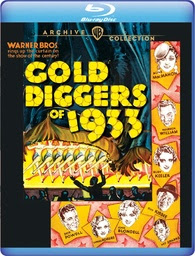
On Blu-ray: Golddiggers of 1933 (1933)


Golddiggers of 1933 is a triumph of cheerfulness and cynicism. Take that opening number, unfolding in the middle of the Depression. A chorus of glamorous showgirls garbed in golden coins, led by the upbeat and impeccable Ginger Rogers, sings about wealth and prosperity moments before their costumes are repossessed for non-payment. They will go home to steal milk from their neighbors, crammed together three to a room. It’s a number that dares to dazzle before quickly cutting to a shot of a producer played by Ned Sparks, chomping a cigar, unimpressed and sour-faced. It lathers on the cheer, but all the while it pokes at the worries of the time, a magnificent feat of escapism and realism combined. 

I was giddy to watch the film again on a new Warner Archive Blu-ray. It certainly looked a lot better than the version I taped off public television as a kid and played to shreds. There’s something special about the films you’ve watched so much that you know every line, glance, and musical cue. 

Golddiggers of 1933 possessed the best Warner Bros. had to offer: direction by Mervyn LeRoy, dance direction by Busby Berkeley, and a cast of the studio’s best players, including stars like Dick Powell, Joan Blondell, and Warren William and beloved character actors Guy Kibbee and Ned Sparks. 

The film’s airy approach to the most dismal topics is remarkable. Starving chorus girls Aline MacMahon, Ruby Keeler, and Blondell lament their hunger and the poverty that has forced them to pawn their clothes and valuables. They also warn each other about handsy show producers, but always with a sarcastic smile and snappy delivery. Men with power like William and Kibbee try to control their world, but the steel beneath these cheery women always comes through, and they find themselves footing the bills for expensive hats and nightclub dinners. 

Every other line tells you this is a pre-code movie and that racy vibe extends to the jaw-dropping Pettin’ in the Park number, which is horny even for the era. Pre-teen Billy Barty is dressed as a baby, rolling around on skates ogling scantily-clad show girls, they pretend to disrobe and shower behind a diaphanous curtain, and the final joke is a baby offering a can opener to a frustrated boyfriend who can’t handle his lady’s metal garb. Describing it all makes it even more astounding that it ever made it to the screen. 

In the end Golddiggers of 1933 triumphs because while it faces reality, it also asks you to believe in millionaire songwriters with open checkbooks, stage productions that hire all your friends, and Broadway shows with a multitude of close-ups that no one in an audience could ever see. It closes with a devastating number about the plight of World War I's Forgotten Man and it somehow leaves you exhilarated. It looks at reality and gives you pure fantasy. 

Among the many special features on the disc from previous DVD releases, there’s an especially interesting newsreel about the 42nd Street Special, a train which crossed the USA packed with film stars promoting Warner Bros. Bette Davis was on that train (and is in the reel); in an interview years later, she recalled that the train was not always well received, because wealthy film stars were the last thing a lot of struggling Americans wanted to see at the time.

Many thanks to Warner Archive for providing a copy of the film for review.

Mar 4, 2022

Podcasts for Classic Film Fans: February Round-up

As you can see from my selection, I had a varied month of podcast listening. Stay tuned next month for the return of my own podcast. I’ve got some fun guests lined up this season! All episode titles link to the shows:
Book vs Movie 
January 27, 2022 

Book vs Movie co-hosts The Margos have started adding other kinds of sources to their podcast, including short stories and in this case, a stage play so they can produce a weekly show. I’ve always been iffy on the movie, Humphrey Bogart was so poorly cast, and I was curious to hear how the play compared. It sounds like a completely different story, with a more worldly and educated Sabrina and stronger, more involved female characters. Now I’m dying to see a stage production of this story.

The Dana Gould Hour 
February 1, 2022 

There’s a lot going on in this entertaining episode: an interview with Jonah Ray (MST3K reboot) which references Tyrone Power, a brief history of publicity king William Castle, and an interesting bit about Alfred Hitchcock, the process of making Psycho (1960), and his search for great material.

The Movies That Made Me 
January 25, 2022 

I love Guillermo del Toro as much for his passion for movies as his filmmaking. It’s pure enjoyment to hear him talk about the films he loves and the many things that make movies great in this wide-ranging conversation. There have got to be many film fans who got into the classics because of his adoration of all kinds of cinema. 


Bloodhaus 
February 3, 2022 

I had high hopes for this art house horror show because co-host (and talented DVD/Blu-ray art designer) Drusilla Adeline is one of my favorite Twitter follows. So far it is promising. The conversation is smart, totally lacking in snobbishness, and infused with some playful elements that made it a little different than your typical movie talk show.

Mar 2, 2022

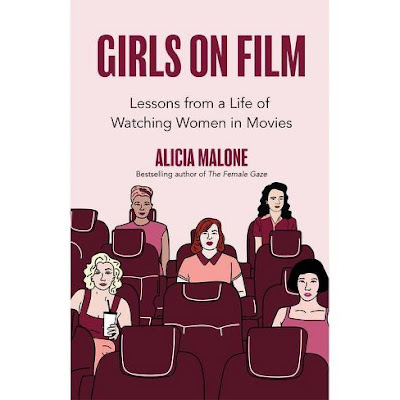
Book Review--Alicia Malone's Latest, Girls on Film: Lessons from a Life of Watching Women in the Movies


Girls on Film: Lessons from a Life of Watching Women in Movies 
Alicia Malone 
Mango Publishing, 2022 

I was delighted to see Alicia Malone had published her third book, Girls on Film: Lessons from a Life of Watching Women in Movies, because I’m a big fan of her writing. Her straightforward, clear style appears simple, but it takes a lot of skill to communicate in such a direct, thorough fashion. 

This time Malone has gotten personal, weaving a memoir into two things that have driven her life: the movies and how women are portrayed in them. I’ve read a few memoirs built around movie-watching, but never one that is so focused on a particular theme. 

Malone has always been inclusive in her writing about film and aware that it is important to draw attention to underseen players in cinema, be they women, people of color, trans and non-binary artists, or other less appreciated and spotlighted populations. Here she draws her own perspective into that issue, admitting that she, like many accepted a cinematic world centered on white, cis, straight men for several years of her film fandom. 

While unpacking her growing understanding of cinema and who and what makes it magical and meaningful Malone focuses on the movies that molded her and the issues most relevant to each title. Chapters are named for an interesting selection of films including Gentlemen Prefer Blondes (1953), Smooth Talk (1985), and Mad Love (the Drew Barrymore film, 1995). The movies are essentially a starting point for a fascinating series of reflections on personal, political, and societal issues, interwoven with a deep passion for cinema. 

Having met many introverted film fans over years of attending the TCM Classic Film Festival, I feel confident that a lot of readers will cringe in recognition, and conversely feel a glow of delight, in the experiences Malone has to share. Many of us have felt the awkwardness of learning about too many life experiences via the often unreliable lens of cinema, of spending a sunny day inside watching movies, and of trying to share that love with a world that generally just doesn’t get classic films. We’ve also found escape, enlightenment, and never ending fascination via our cinematic obsessions. She may be more ambitious, glamorous, and focused than the typical film fan, but Alicia Malone is definitely one of us. 

I’ve often felt frustrated that there are not more celebrated female film critics at the level of Siskel, Ebert, Maltin, and the like. In reading this book I realized that Alicia Malone has everything required to deserve that kind of status. I don’t feel there is yet the societal will to properly elevate and celebrate a woman of her intelligence and insight as a thoughtful authority on film (I hope I am wrong), but she has the goods.

Many thanks to Mango Publishing for providing a copy of the book for review.