I have been having a blast making YouTube videos lately. My two most recent uploads are tributes to a pair of my favorite actors: Barbara Stanwyck and Cary Grant. I'm going to be posting more frequently on the channel, as I have a lot of things to explore, so if you haven't already, follow me over there to keep in the loop!

Showing posts with label Barbara Stanwyck. Show all posts
Showing posts with label Barbara Stanwyck. Show all posts
Aug 9, 2023

Jan 12, 2022
Crime on Blu-ray: Ladies They Talk About (1933) and Angels With Dirty Faces (1938)
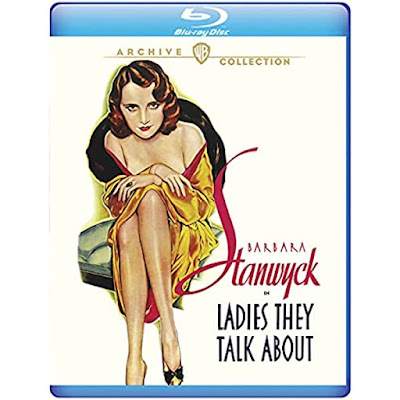
As I watched the new Warner Archive Blu-ray releases of the crime flicks Ladies They Talk About (1933) and Angels with Dirty Faces (1938), I was struck by how differently the stories unfolded. Aside from the gender differences in the leads, their tone varied, from pre-code naughtiness, to post-code morality. I think both are classics in their way though.
Ladies They Talk About is the purest distillation of the pre-code era. Barbara Stanwyck stars as a moll who ends up in a prison with unusual privileges. Women in lingerie live it up in cells that look like dorm rooms and they delight in their bad behavior. You wouldn’t see any of this enjoyment in the crime films that came with code enforcement.
Stanwyck is perfect for her role as a slightly marshmallow-hearted dame gone wrong. While you never really believe that the crusading preacher (Preston Foster) who wants to save her could ever satisfy her, she doesn’t seem to have many other options. While she’s in prison for helping her gangster boyfriend pull off a bank robbery, she has plenty of time for racy literature, listening to her pal croon adorable songs (the always delightful Lillian Roth), and enjoying the salty repartee of a seasoned madam who lays claim on the rocking chair in the common room.
It’s snappily-paced fun that’s clearly a precursor to the women-in-prison films to come, from the grimmer, but equally lively Caged (1950) to exploitation flicks like Caged Heat (1974).
Special features on the disc include the cartoon I Like Mountain Music and a theatrical trailer.
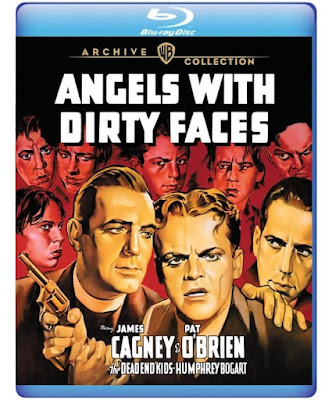
Every time I watch Angels With Dirty Faces, I wonder what it would have been like if it had been made in the pre-code era. There are moments when it could use a little more edge or a bit of spice, but there’s also a craft to it that came with the maturation of cinema.
The story blazes into action with that special brand of Warner Bros. efficiency, introducing tow childhood friends who take different paths with sharp, short scenes and a snappy montage sequence. When we finally settle in with the grown up Rocky (James Cagney), who is a lifelong gangster, and his friend Father Connolly (Pat O’Brien) who is working to help the boys in the neighborhood avoid the same fate, you know the important details; the characters have come alive.
In typical Warner Bros style, the supporting players are as dynamic as the leads. While the Dead End Kids have always struck me as a bit corny, they are always lively and fascinating. Ann Sheridan and Humphrey Bogart also make a lot out of less showier parts.
Cagney and O’Brien are great in their roles because they subvert the typical expectations of the parts they play. While Rocky is a morally loose tough, his eyes mist when he hears a young boy sing a soaring solo in a church choir and he is gentle and encouraging with love interest Sheridan, instead of crude and possessive. O’Brien has an appropriately street-smart edge as a priest who rather than taking a scolding or moralizing tone, faces the challenges of the kids he wishes to save realistically, meeting them where they live.
The film has become a classic because of the emotional power of its shock ending, but that finale wouldn’t have half the impact without the strong character development and artful filmmaking preceding it.
There are several special features, all of them carry-overs from the DVD release, it features the Leonard Maltin-hosted Night at the Movies 1938, which includes a newsreel, the musical short Out Where the Stars Begin, a Porky and Daffy Cartoon, and theatrical trailers, there’s also a featurette about the film, commentary from film historian Dana Polan and a radio production with the film’s stars.
Many thanks to Warner Archive for providing a copy of the film for review.
May 2, 2015
Screenshots of The Week: The Recycled Dress

Barbara Stanwyck's bold button collar dress in Baby Face (1933) is worn again by an office worker in Housewife (1934):

George Brent is in both films too!
Dec 2, 2013
Book Review--A Life of Barbara Stanwyck: Steel-True, 1907-1940
.jpg)
A Life of Barbara Stanwyck: Steel-True, 1907-1940
Victoria Wilson
Simon & Schuster, 2013
It's impossible not to ask the question: how can you justify writing 1,000 pages about thirty-three years of a life? The answer is both intimate and grand. Stanwyck is uniquely worthy of careful attention for her impact on her industry, but also for what she stood for, for her grit and for the times she lived through, from the New York theater world of the teens and twenties through the early talkies, World War II and the years leading up to and after the studio age.
She was active throughout enormous social changes and always managed to stay with the times. And yet, there was a loneliness to her. She clung to whatever family she could find, while simultaneously protecting herself from the world around her.
Wilson has made Stanwyck the center of a history that includes the social, political and artistic life the goes on around her. It's as if the book is an epic mini-series and she is the star. She floats and fights in this vibrant world; you can sense its energy pulsing around her. Not many subjects could justify this kind of attention to detail. A woman as complicated as Barbara Stanwyck practically demands it.
Sometimes I would become impatient with the scope of the story. Stanwyck can disappear for several pages while Wilson devotes her attention to a detail of the Roosevelt administration or a Hollywood scandal. As a whole it works though. It's a big, juicy story. Fifteen years of enthusiastic research woven into an addictive whirl of lives and events, with its subject perched on top.
Barbara Stanwyck was orphaned at four, a showgirl by her teens and in a short period of time advanced to dramatic roles on the stage. Independent, tough and hardworking, she funneled the emotion of her turbulent life into passionate, moving performances. Hollywood followed, and there she allowed directors like Frank Capra to mold her rough, natural talent so that she became a screen actress of breath-taking power, drawing as much emotion from the film crew as theater audiences.
The book takes the star from her rough childhood and early years on the stage, through her stifling, abusive marriage with Frank Fay and early screen stardom, to a more easygoing relationship with movie heartthrob Robert Taylor. In thirty-three years she advances from poverty to wealth, obscurity to worldwide stardom. She succeeds through the force of her talent, and yet she struggles to relax and to enjoy her success. Always fighting to keep up her weight up, drinking twelve cups of coffee a day and reading through the night due to insomnia, any happiness she finds has an edge.
Stanwyck confounded many with the extremes of her personality, friendly and open to some, frosty and distant to others. Sometimes she'd shift from one to another with a single, baffled friend. She was often on guard. Still, she overcame the hurt and dysfunction of her early life to build many strong relationships and even occasionally grab a little fun.
Steel-True ends on a tense note, with World War II ready to explode. Stanwyck has finished Remember the Night (1940), with costar Fred MacMurray, and she is preparing to work with director Frank Capra for the fifth time on Meet John Doe (1941). She's already seen enough for a lifetime, but there is so much more waiting in the years ahead. Even a partial list of films to come is enticing: The Lady Eve (1941), Double Indemnity (1944), Christmas in Connecticut (1945), The Strange Love of Martha Ivers (1946), The Furies (1950) and The Thorn Birds (1983). I don't know how I'm going to distract myself until the next volume arrives.
Many thanks to Simon & Schuster for providing a review copy of the book.
Jul 22, 2013
Barbara Stanwyck in Baby Face (1933): Dressing to Win

This post is my entry in the Barbara Stanwyck blogathon
hosted by The Girl with the White Parasol. Go to her site to check out the rest
of this amazing event.
The idea of a woman empowering herself by polishing her
appearance is familiar in the movies. Just think of The Women (1939), where
getting a manicure with "jungle red" nail color was as good as a
battle cry. Or Joan Crawford advancing from her awkward small town ways and
gingham dresses to wealth and slinky dresses in Possessed (1931).
In Baby Face (1933), Barbara Stanwyck takes the concept of
dressing for success to a surreal place as Lily, a cynical woman determined to
work her way up in the world man-by-man. Her simultaneously gorgeous and
bizarre Orry-Kelly costumes, fanatically sculpted hair, serve as both armor and
plumage in her battle to live a penthouse lifestyle.
And Stanwyck really works those clothes and 'dos. She deliberately shows her character using them as tools for her world domination. There's
no joy in this woman's appropriation of fashion. Think of all the actresses who
would be gobbled alive by the frocks in the shots to follow. Stanwyck slides
into them like they are a second skin.
Lily hasn't got a concept of success in her first scenes.
Working in her sleazy father's speakeasy, she can afford only the most basic
clothing. In her simple blouse and skirt, which are not sexy, but also not
dowdy, she unsuccessfully attempts to deflect the lust of her father's grabby
customers.
Though Lily has plenty of fight in her, she feels powerless, and
this is reflected in her slouching posture, barely tucked in shirt and blank
expression. Her hair is loose and untamed, much like the undisciplined and
aimless Lily. She is scolded by the Nietzsche-quoting local cobbler for her
lack of ambition, but she can't see life beyond her bleak circumstances:

Then Lily's father dies in a still explosion, and the
cobbler tells her to use the power of sex to make her way in the world. With no
other worthy prospects ahead of her, she decides to take her mentor's advice. A
gingham dress and a tight blazer show off enough figure to get her started. She
flirts with the doorman at a swanky bank skyscraper and sleeps with the male
receptionist in personnel. So far she doesn't need much more than her sex
appeal, but that bright red lipstick can't hurt:

Now that she's making money, Lily upgrades her look. Check
out those buttons; they almost make her dress look like a military uniform! But she knows her costume isn't complete. She
needs a helmet before she can truly go into battle. She admires a coworker's
permanent:

With her hair helmet in place, Lily is ready to move up in
the world. Sorry young man (that's John Wayne before he was a cowboy), you're cute, but you
don't have the cash to cut it with this gal:

Lily also starts working on that plumage, she gets lots of showy
dresses and all the while that hair gets more rigid and helmety:


Once Lily works her way up to the executive class, she can
quit her job and soften up her look. After all, a kept woman needs only to
lounge:


Even this showy trim is soft and cozy:

The woman is still keeping sharp though. She's in the habit
of fighting for survival. Despite the lovely negligees, her hairstyle is even
more severe:

It actually looks like this ancient Roman helmet:

Lily could go on like this for years, but her conquests
can't take it. A murder-suicide and a big old scandal cut off her cash flow. She
tries to make her case to the bank's board dressed demurely in a sweetly tipped
hat and lace scarf:

She still has that killer look in her eyes though. The newly
instated playboy bank president isn't having it. He knows her kind. She is
packed off to work in the bank's Paris office. There she sticks with the lace
and tilted hat, but for the first time her clothing seems to reflect her true state of mind:

She softens her look:

When that playboy bank president flirts with her on a business
trip to Paris and takes her out to a nightclub, she hasn't got an agenda, and
that shows in her gracefully-draped evening gown. Notice how her curls have
relaxed a bit too? They no longer seem to be standing at attention.

Look in her eyes though, she's falling for him, but she's still
hard inside. It's amazing the complexity Stanwyck brings to this simple role:

When Lily is finally legit,
married to her bank president, she is truly in love, but the battle scars from
her early life remain. That conflict is reflected in her final gown, which is
soft and drapey, but also accented with a metallic collar. It's as if she can't
shed that last bit of armor, and that's just what she needs to do to be happy:

There's so much to love about
Stanwyck in this movie, but I've always been most impressed by the way she
subtly and maybe not even consciously uses her costumes and grooming to build
her character. It is traits like these that made her characters more substantial, not just a glittering fashion plates, but a fully-formed women.
Jul 15, 2012
Quote of the Week

When youngsters ask me how to act, I say, 'Don't. Re-act! Don't act!'
-Barbara Stanwyck
Image Source, Quote Source
May 27, 2012
Quote of the Week

She couldn't get out of her own way. . . . She wasn't disciplined. . .but she didn't do it viciously, and there was a sort of magic about her which we all recognized at once.
-Barbara Stanwyck, about Marilyn Monroe
Image Source, Quote Source
Apr 29, 2012
Quote of the Week

I have never heard one person get as many vibrations into her voice as Barbara got into hers then. It was like a symphony chorus in the Hollywood Bowl instead of just one person speaking.
-Mae Clarke, about Barbara Stanwyck
Image Source, Quote Source
Mar 6, 2012
Book Review-- Barbara Stanwyck: The Miracle Woman

By Dan Callahan
University Press of Mississippi
2012
Barbara Stanwyck: The Miracle Woman is more a critical review of Stanwyck’s career than a traditional biography. This is an appropriate choice, because the woman lived to work. Author Dan Callahan demonstrates how her anger, frustration and the violence and neglect of her hard-luck childhood helped to mold her performances. For what is essentially a career assessment, he ends up revealing a great deal about her character. I’ve been reading about Stanwyck for years, and I feel like I’ve never known her better.
The book is divided by films, with some chapters consisting of several movies from certain periods, such as pre-codes, and films made with specific directors including Frank Capra and Preston Sturges. Some are grouped into genres, including Stanwyck’s favorite, the western. Movies with a big reputation are given their own chapters, even if the author does not necessarily feel them worthy of the extra analysis.
This respect for popular and critical attention to Stanwyck’s films helps to keep the book from drowning in personal opinion. Callahan is clearly a fan, and he has strong views on Stanwyck’s work. Sometimes this drove me crazy, and I felt like I was in a coffee shop having an argument after seeing a film. Often I gained a new, and sometimes delightful, perspective from his analysis. Overall, these opinions come from a knowledgeable critic. Callahan has clearly done his research and has spent enough time in Stanwyck’s world to have a good idea where she came from and how she operated.
I relished the detail in Miracle Woman. It pays great tribute to the small gestures and moments that can color a whole performance. Stanwyck was not a stage actress; she worked specifically for the camera, and by understanding the nuances of her acting, Callahan captures much of what made her so arresting.
There’s a lot of plot detail in the book, including spoilers, and it could be frustrating reading for those who have yet to dig deep into Stanwyck’s filmography. I believe that these kinds of readers would find it worthwhile to attempt to skim past those plot points before seeing the films. I found myself both curious to check out the films I hadn’t seen and to re-watch titles I’d already seen many times. Even the supposedly lousy movies seemed intriguing once I learned more about them.
I’d love to see this author try the same treatment with different actors, though I suspect that he’d have to be as invested in them as he is Stanwyck. You get the sense he cares about her, and that he is as aware of her faults as her strengths. It is that quality which lends the book a special sensitivity. He demonstrates an understanding of Stanwyck that helped me to trust his point of view. I was open to hearing her story from his perspective, whether or not I agreed with his conclusions.
Thank you to the University Press of Mississippi for the opportunity to review this book.
Oct 16, 2011


May 29, 2010
Saturday Newsreel: The Stars Arrive
Barbara Stanwyck, Robert Taylor, Stan Laurel and Oliver Hardy chat with reporters as the Queen Elizabeth approaches the shores of Southampton. (I can't believe Taylor has to maintain that teeny little mustache while on vacation; what a drag.)
Jan 4, 2010
Monday Serenade: Barbara Stanwyck
How did they get away with the barely double entendre in Take It off the E-String? Not only is this obviously a scanty underwear-related ditty, but it's performed in a burlesque house in the appropriately named Lady of Burlesque (1944). Another mystery: why do I enjoy watching Barbara Stanwyck singing and dancing so much when she is plenty shaky when it comes to both skills? I wish she had filmed herself reading the phone book before she passed, because I have the feeling I would enjoy that as well.
Jul 16, 2009
The Explosive Barbara Stanwyck

I feel inspired to pay tribute to Barbara Stanwyck today, on what would have been her 102nd birthday. She’s one of my favorite actresses, partly because while her efficient, regular Jane persona made you want to refer to her as “Babs” or “Stanny”, she was also was such a towering, forceful talent, that you might also be inclined to bow to her and call her ma’am. There are bad Stanwyck movies, but not bad Stanwyck performances; she was regular in that way as well.
While Stanwyck could play anything from the sunniest screwball heroine to the most sinister femme fatale, I always like her best when she plays a fighter, a down-on-her-luck woman with much to overcome and the will to win. She’s incredibly powerful in those moments when she gets fed up with the battle and unleashes a firestorm of anger. That’s why I love these three Stanwyck movies:
Miracle Woman (1931)
In this brisk pre-code, Stanwyck is the daughter of a small town preacher. When the insensitive actions of his congregation lead to his death, his furious daughter goes on the war path. Stanwyck berates her father’s parishioners with shoulder-rattling rage so powerful that she ends up clearing out the church. Here’s proof that right from the beginning of her career, Stanwyck was a mesmerizing performer.
Baby Face (1933)
This time Stanwyck’s lousy father gets a piece of her mind. Fed up with his trying to pimp her out to his speakeasy customers, she berates him for destroying her life with fire-spitting fury. Not long after, he blows himself up in his still and she takes off for the city to make her fortune by turning the tables on the male race.
The Furies (1950)
Yet another bad father raises Stanwyck’s ire in this gloomy, symbolic western. Papa Walter Huston has her lover hanged and it is enough to kill his daughter’s life-long admiration for him. Sitting tall on her horse, she unleashes a tirade that is only the start of her bitter quest for revenge.
Image Source

Jul 9, 2007
The Hollywood Tirade

In real life, when you lose your temper, you've only given up something you can't get back. In the movies, losing your temper can be the key to stardom, accolades and audience sympathy. These three women unleashed some of the best tirades of classic Hollywood:
The Miracle Woman (1931), Barbara Stanwyck
No one could play the hurt woman pushed too far better than Stanwyck. Some of her best screen moments are when her voice deepens, her shoulders begin to shake, and the floodgates open.
She has one of her best tirades as Faith Fallon, a preacher’s daughter. When her father is abruptly fired after years of service, he dies from the shock, right before he is to give his last sermon. Heartbroken, Faith stands at the pulpit, where her father once stood, overcome with anger. She assaults the congregation with torrent of angry accusations that send them running out of the church, as if she is shooting them with arrows. She follows them, walking down the rows of pews until finally she is alone, exhausted and entirely lacking in the faith that used to guide her life. It is one of the most devastating scenes of Stanwyck's career, and an early sign of the enormity of her talent.
Bombshell (1933), Jean Harlow
Harlow had a rough start in Hollywood, primarily because she won fame for her looks before she learned how to act. Though no one could take their eyes off her, they couldn't stop laughing at the absurd accent she'd picked up from her acting coach either.
Comedy was Harlow's salvation. Though she was tired of playing tramps, she gave her career new life by playing a funny tramp in Red Headed Woman (1932). Harlow built on her newfound respect with Bombshell. She plays Lola Burns, a movie star victimized by fame and its trappings.
Lola loses her temper many times before the final credits, but her best tirade is near the beginning of the movie, where she is constantly thwarted in her attempts to get to work. Surrounded by hangers-on and barking dogs, she vents her frustration in a long, fast-paced speech during which she hardly seems to take a breath, all the while trying to gather her effects and get out the door. Here is ample proof that Harlow was one of the best screen comics.
Of Human Bondage (1934), Bette Davis
"You disgust me." When Philip Carey (Leslie Howard), rejects slatternly waitress Mildred (Bette Davis) with these words, he realizes his mistake instantly. She turns from a gooey-eyed lover into a vicious beast. Her eyes widen, her shoulders rattle back and forth and she launches into a tirade so harsh that time has not diluted its power.
Davis spits out her lines as if they are bitter seeds. Her eyes bug out and the veins her neck are so strained they look as if they could explode. It is a moment that could be overplayed so easily; everything she does teeters on the edge of absurdity, but she hones in on Mildred's anger with a precision that gives the moment unbearable intensity.
Comedy was Harlow's salvation. Though she was tired of playing tramps, she gave her career new life by playing a funny tramp in Red Headed Woman (1932). Harlow built on her newfound respect with Bombshell. She plays Lola Burns, a movie star victimized by fame and its trappings.
Lola loses her temper many times before the final credits, but her best tirade is near the beginning of the movie, where she is constantly thwarted in her attempts to get to work. Surrounded by hangers-on and barking dogs, she vents her frustration in a long, fast-paced speech during which she hardly seems to take a breath, all the while trying to gather her effects and get out the door. Here is ample proof that Harlow was one of the best screen comics.
Of Human Bondage (1934), Bette Davis
"You disgust me." When Philip Carey (Leslie Howard), rejects slatternly waitress Mildred (Bette Davis) with these words, he realizes his mistake instantly. She turns from a gooey-eyed lover into a vicious beast. Her eyes widen, her shoulders rattle back and forth and she launches into a tirade so harsh that time has not diluted its power.
Davis spits out her lines as if they are bitter seeds. Her eyes bug out and the veins her neck are so strained they look as if they could explode. It is a moment that could be overplayed so easily; everything she does teeters on the edge of absurdity, but she hones in on Mildred's anger with a precision that gives the moment unbearable intensity.
Subscribe to:
Posts (Atom)